

Tuesday at 11, the chair is empty. Thursday at 3, same thing. And your Friday 10 o'clock never showed up and never called.
The first idea is almost always the same: I need new customers. So, ads. Or a discount.
We've seen plenty of businesses with a schedule that looks exactly like that. What we noticed is that the money wasn't leaking for lack of new customers. It was leaking in two places, the gaps in the schedule and the missing explanation. At a salon, it's the empty slots from Tuesday to Thursday and the people who don't show up. At an auto shop, it's the driver who doesn't come back because nobody explained what was done to their car.
Below are two 30-day plans. Read yours and start with week one.
At a salon, you lose money on Tuesdays and on people who don't show
We'll start with no-shows, because that's where the biggest surprises are.
How many missed appointments do you have a month? If you don't know exactly, you're in the same spot as everyone else. We haven't found a solid, independent no-show rate for US salons. The numbers floating around usually come from companies that sell booking software. So measure yours, for one month.
The serious research on no-shows comes from healthcare, not salons. We're telling you that straight, because the situation is the same: someone booked a time and didn't show up.
A 2016 review in BMJ Open that pooled clinic studies on text reminders found that with reminders, no-shows dropped to about 15%, from about 21% without them. Several reminders worked better than one. That's a real drop, and it's not a miracle. If someone promises you miracles from reminders, ask where their numbers come from.
What the reminder says matters too.
In 2019, at hospital clinics in New South Wales, Australia, texts that told patients what a missed appointment cost the hospital cut missed appointments by 33.7% (4.3 percentage points). The UK's Behavioural Insights Team had found a 32% drop back in 2015, also with messages that mentioned the cost.
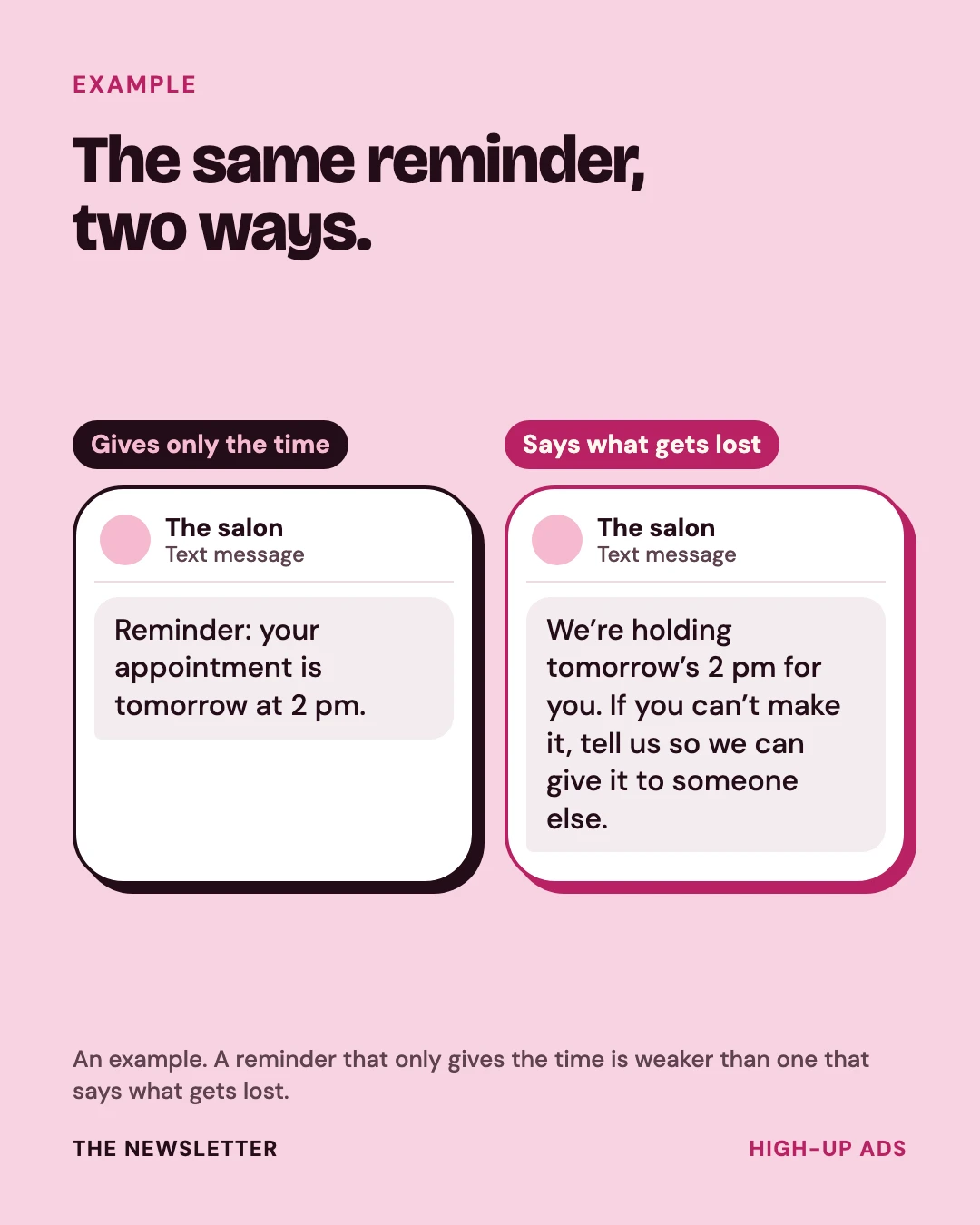
In short, a reminder that only gives the time is weaker than one that says what gets lost.
At a salon, the cost isn't a dollar figure on paper. It's the slot you held for them that someone else wanted. So your reminder goes something like this: "We're holding tomorrow's 2 pm for you. If you can't make it, just tell us so we can give it to someone else."
The second thing is the next appointment. You book it before they leave, while they're still in the chair. Not "we'll be in touch" and not "just text me."
If you read our issue about a restaurant's quiet nights, that one was about occasions and how you invite people in. This is different. Your customers are already booked. They just need to show up, and then come back.
The first 30 days at a salon
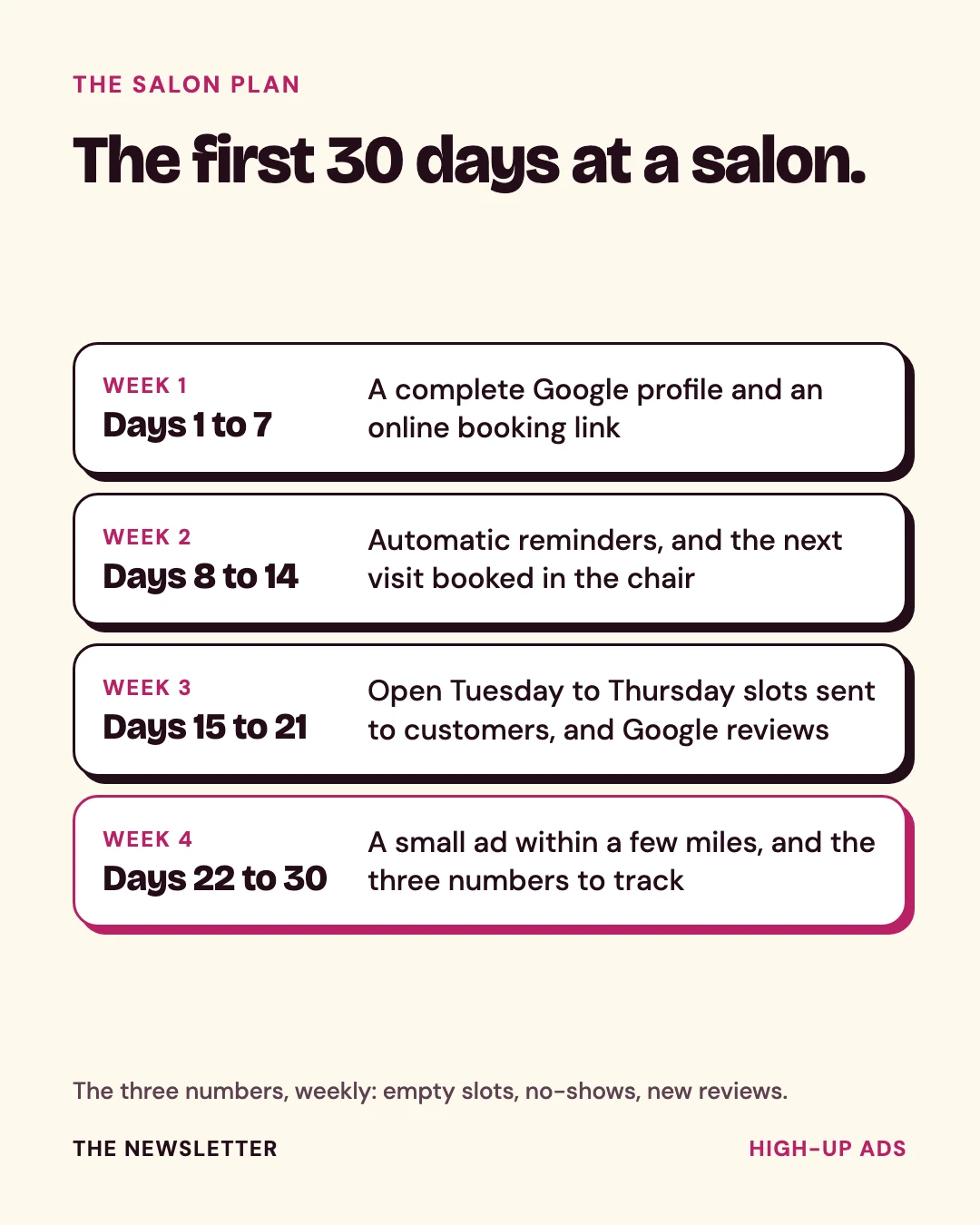
Days 1 to 7: a complete Google profile and online booking.
In its Business Profile help pages, Google says local results are "mainly based on relevance, distance, and popularity," and that more reviews and positive ratings can help your ranking. It also says something worth reading twice: "There's no way to request or pay for a better local ranking on Google."
That means you have to put the work into your profile. Google recommends a verified, complete profile with your hours, photos, videos, and replies to reviews. For a salon, that comes down to the right categories, every service with its price, your regular hours plus special hours (holidays, for example), and real before-and-after photos.
Why aren't your Instagram photos enough? Because people don't look in just one place. In BrightLocal's 2025 survey of 1,026 US adults, 74% use two or more review sites, with YouTube and Instagram among the main alternatives, and more than three-quarters watch video when they look up a local business. So your photos need to be on Google too, where the person searching finds you.
This same week, add an online booking link to your profile for the customer who's looking at night, when the salon is closed. Google lets you connect a booking provider or add your own booking link to your Business Profile. If your booking app works with Google, set it up now.
Days 8 to 14: reminders.
Set up an automatic reminder the day before and a second one 2 to 3 hours before. Both say what gets lost, not just the time: "we're holding this slot for you; if you can't make it, tell us so we can give it to someone else."
Starting this week, the next appointment gets booked before they leave, in the chair. Every time.
Days 15 to 21: open slots and reviews.
Your open slots from Tuesday to Thursday go to the customers you already have, by text or in your Instagram Stories. Not as a public discount. We have a separate piece on discounts, so we'll leave it at that here.
Also this week, ask every happy customer for a Google review, with a direct link. On Google, because that's where it counts for ranking.
Days 22 to 30: now the ad comes in.
A small Facebook and Instagram ad, within a few miles of the salon, with the best before-and-after video you've got.
Starting this week, track three numbers every week: empty slots, no-shows, new reviews.
At an auto shop, drivers come back when someone explains the work
Now the auto shop.
It's a crowded, fragmented market. In 2023, the US had 169,572 auto repair and maintenance locations with employees, and 83.6% of them had fewer than 10 people (Census Bureau, County Business Patterns). Your competition is a couple of blocks away, and most of the time it's just as small as you are.
So what makes a driver come back?
Start with why drivers stop trusting a shop. In a AAA survey of 1,001 US drivers (September 2016), 63% said they generally don't trust auto repair shops. The top reasons were recommendations for services they didn't need (76%) and overcharging (73%). Both come down to the same thing: the driver can't see what was needed or why it cost that much.
When YouGov asked more than 11,000 US adults in 2024 what matters in a place to get their car serviced, good customer service came first (55%), then a convenient location (45%) and reputation, reviews included (44%). Transparent pricing got 37% and technician certifications 33%. A lounge or waiting area? Just 13%.
Word of mouth still counts. 30% named a recommendation from someone they trust, and AAA's own advice to drivers is to ask family and friends before anything breaks.
And price? Cox Automotive's 2025 study of 1,974 vehicle owners found the average repair at a dealership cost $261, less than the $275 average at general repair shops. Even so, 45% were unhappy with dealership service, mostly over unexpected costs and poor communication. So we won't tell you price doesn't matter. We'll tell you it isn't the first thing that brings a driver back.
Romania, where our team is based, has a sharper number. In a 2022 Castrol survey of 1,000 car owners there, the top reason drivers stayed with a shop (40%) was that it explained the work and asked for approval before doing it.
The whole plan starts from there. An independent shop doesn't beat the dealership on price. It beats it on what the dealership does badly: explaining.
ASE and the FTC already tell drivers to look for certified shops. Make sure they can find yours
ASE certifies technicians by test area, from brakes to engine repair. A shop earns the ASE Blue Seal when at least 75% of the technicians who diagnose and repair are certified and every service it offers is covered by at least one certified tech. ASE lists those shops in a free locator for drivers.
The FTC's advice to drivers is just as direct: look for shops that display certifications, and get a written estimate. In some states the rules have teeth. In California, a shop has to give you an estimate and can't start work until you authorize it (by text or email is fine), and drivers can look up a shop's license and past disciplinary actions online (Bureau of Automotive Repair).
If your techs are certified, ASE and the FTC are basically telling drivers to come find you. For free. The catch is that a certificate on the wall behind the counter does nothing for someone searching at home, and a sign that just says "ASE certified" doesn't tell the driver certified in what.
A third of the US adults YouGov asked rate technician certifications as important (2024). That driver wants to know whether your tech is certified in brakes, in engine repair, or both.
The first 30 days at an auto shop
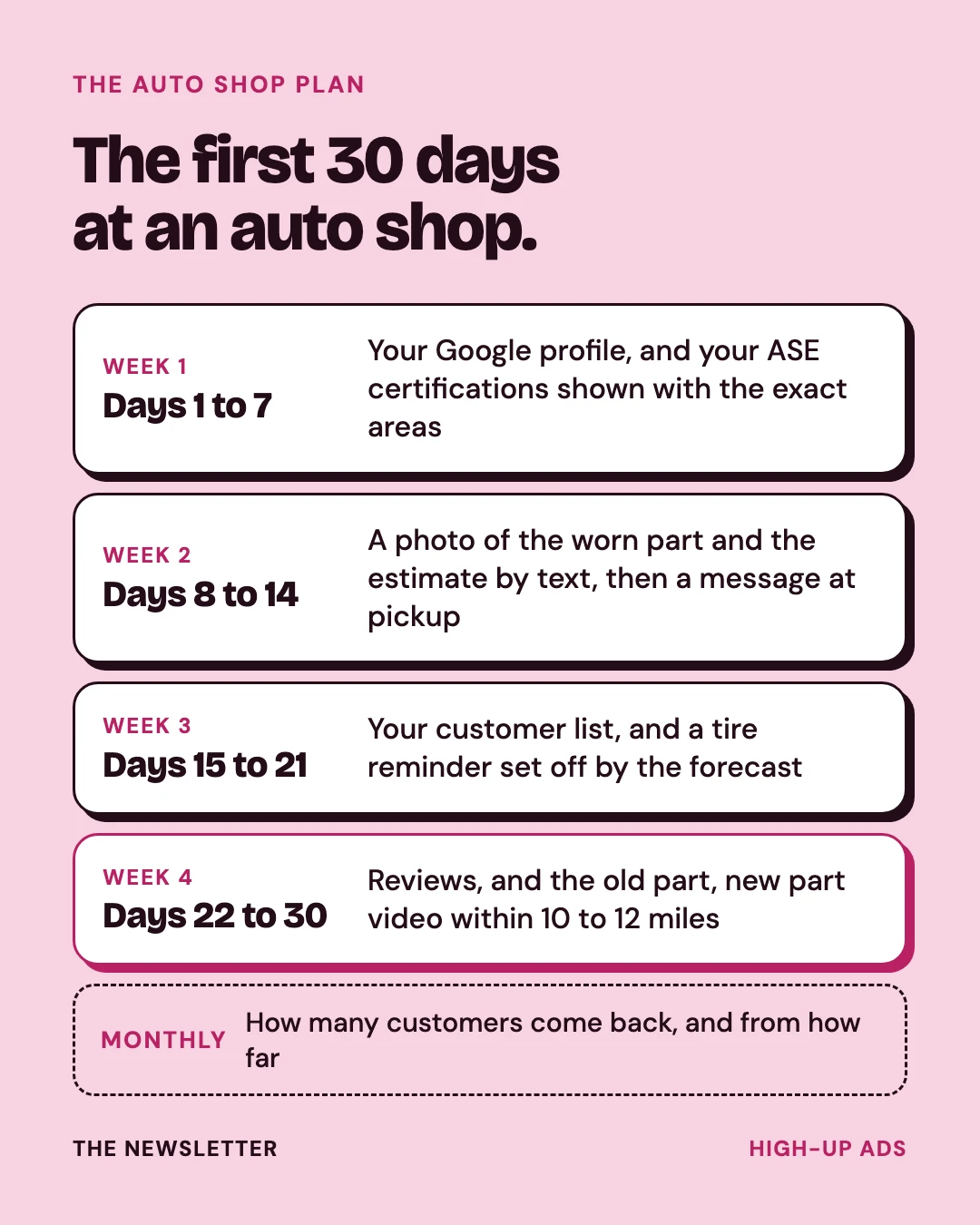
Days 1 to 7: your Google profile and your ASE certifications.
Complete your Google profile with the same rules as the salon: verified, with regular and special hours, and real photos.
Show your ASE certifications, with the exact areas, in three places: in the shop, on your Google profile, and on your website. If your state registers or licenses repair shops, put that number there too.
Days 8 to 14: the photo-and-OK rule.
The rule goes like this: "a photo of the worn part and the estimate by text; we don't touch anything without your OK."
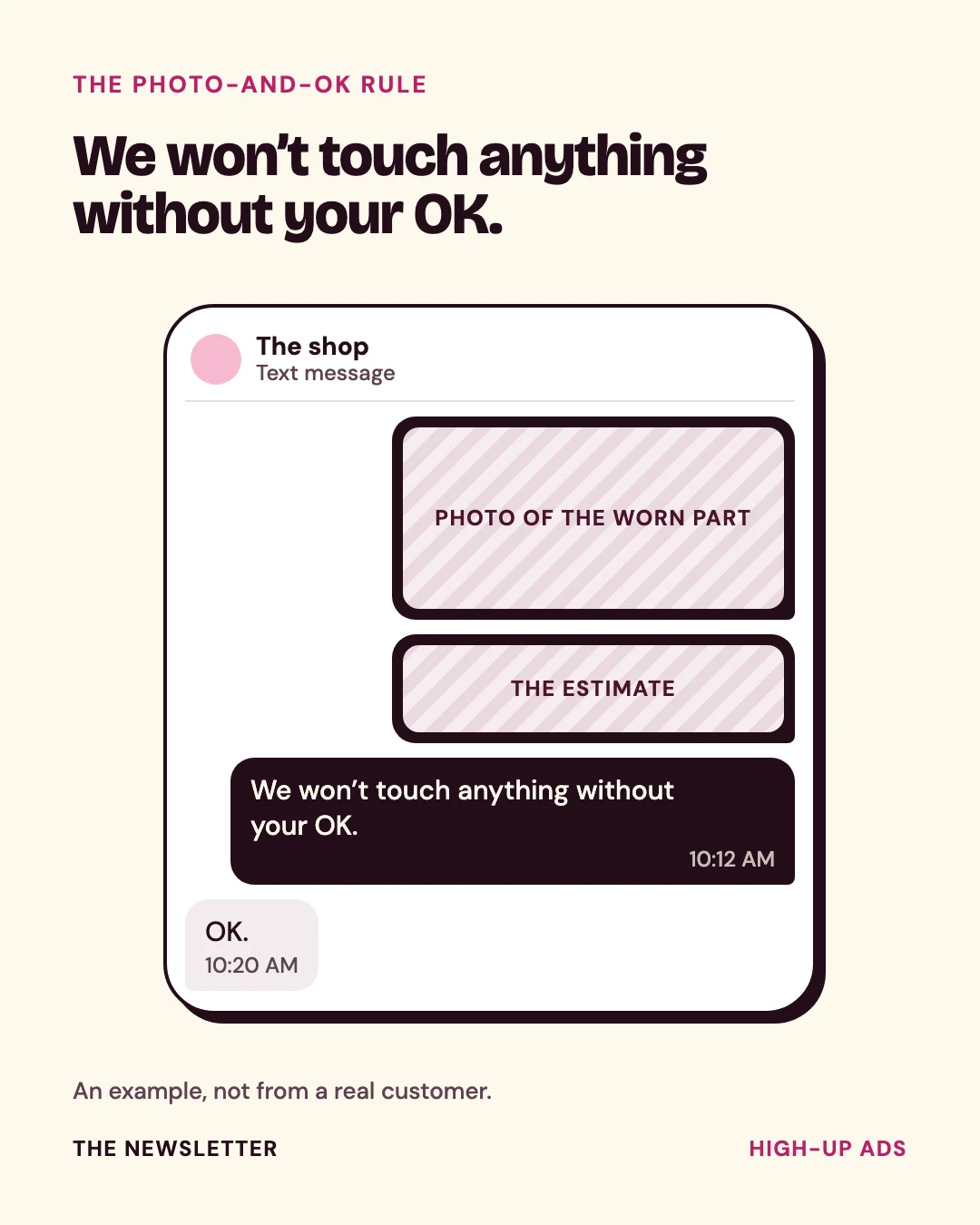
And when you hand the car back, send a message with what you replaced and why. That goes straight at the top complaints in the AAA and Cox surveys: work the driver didn't think was needed, surprise costs, and poor communication.
Days 15 to 21: your customer list and tires.
Build your customer list, each one with the date of their last visit.
Then get the tire reminder ready. This is where timing gets tricky. There's no fixed date when people switch to winter tires. In snow country, demand starts with the first snow.
So send the reminder when the forecast calls for the first snow, and put your open slots in it. We're heading into the cold months right now, so this year you can get it right. In a warm state, the same idea works with an AC check before the first heat wave.
Days 22 to 30: reviews and the video.
After every job that went well, ask for a review. On top of that, shoot a short "old part, new part" video and promote it within 10 to 12 miles of the shop.
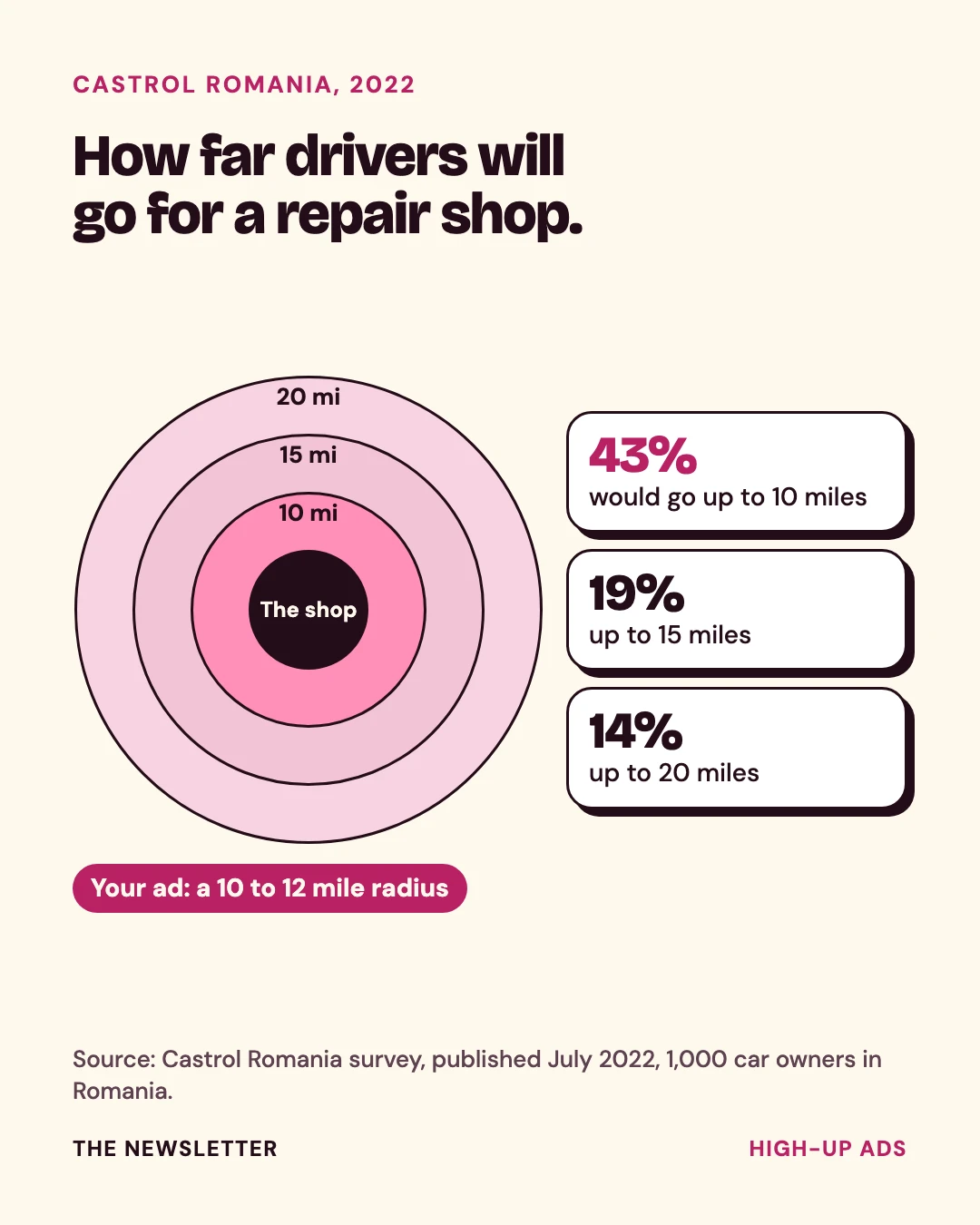
Why 10 to 12 miles? We don't have a solid US number for how far drivers will go. The best one we've seen comes from that same Castrol survey in Romania: 43% of drivers said they'd drive up to 10 miles for a shop that explains the work and treats them well, 19% up to 15 miles, and 14% up to 20 miles. Most of your customers live close. Check it against your own invoices by looking at last year's ZIP codes.
Monthly: two numbers.
Once a month, check how many customers come back and how far away they come from.
These mistakes keep the schedule empty, at the salon and at the shop
At the salon, the first mistake is filling gaps with a public discount. The second is asking for reviews only on your booking app and not on Google, where they count for ranking. The third is keeping your before-and-after photos only on Instagram. The fourth is having no booking button for the customer who looks at night. The fifth is a reminder that only gives the time.
At the shop, the most expensive mistake is competing on "cheapest," when drivers' biggest worries are paying for work they didn't need and getting hit with surprise costs. Next comes selling the coffee and Wi-Fi in the waiting room instead of selling the explanation. Then advertising across the whole metro area instead of 10 to 12 miles out. Not keeping a customer list with the date of the last visit. And starting your tire campaign on a calendar date instead of when the forecast calls for snow.
If you'd like to walk through the 30-day plan for your own business, you can do it with Oana in the free audit: an hour on Zoom or Google Meet.
- BMJ Open: Using digital notifications to improve attendance in clinic, systematic review and meta-analysis (2016)
- NSW Government: Using reminders to cut missed hospital appointments
- Google Business Profile Help: Tips to improve your local ranking on Google
- Google Business Profile Help: Bookings through a booking provider
- BrightLocal: Local Consumer Review Survey 2025
- US Census Bureau: County Business Patterns 2023
- AAA: Auto repair consumer survey (2016)
- YouGov: US car owners' preferred auto service locations and key decision factors (2024)
- Cox Automotive: Service Industry Study (November 2025)
- ASE: Blue Seal of Excellence recognition program
- FTC: Auto repair basics
- California Bureau of Automotive Repair: Maintenance and repairs
- AutoMarket.ro: Castrol Romania study on repair shop loyalty (July 2022)
- HIGH-UP ADS: Your restaurant is packed, just not every night




Written by the HIGH-UP ADS team: Oana, Lorena, Marian, and Stefan.