

Think back to your last big sale. You put up the percentages, sent the emails, got the orders. Then you looked at the numbers and weren't sure you'd made anything.
You've probably noticed something else this past year: without a discount, things don't move. Some customers won't buy at full price anymore. They look, they leave, and they come back when there's a deal.
You're not the only one. And it's not your customers' fault.
A customer who waits for the sale isn't a bad customer. It's a customer you trained, month after month, with every promotion. The good news is that a learned habit can be unlearned. You just have to know how, because there's also a wrong way to do it, and we know what it costs.
Let's take it one piece at a time.
Black Friday keeps setting records, and shoppers have learned to wait for it.
In the US, Black Friday 2025 brought in a record $11.8 billion online, up 9.1% from 2024, and the five days from Thanksgiving through Cyber Monday brought in $44.2 billion, according to Adobe Analytics.
Big numbers. Now look at what it took. On Cyber Monday 2025, discounts peaked at 31% off on electronics, 28% on toys, and 25% on apparel (Adobe again).
When you compete on price alone on Black Friday, you're up against Amazon, Walmart, and Target on the one day they plan all year for. A small business doesn't win that fight with another 5% off.
Shoppers have adjusted to those discounts. In a BCG survey of more than 10,000 people in 10 countries, the US among them, run in September 2025, about 77% across the 10 countries said they sometimes or often put off purchases earlier in the year to catch the year-end deals. The main threshold for a good deal: around 30% off.
Read that first number again. People who want something now put it off, because they've learned that later is usually cheaper.
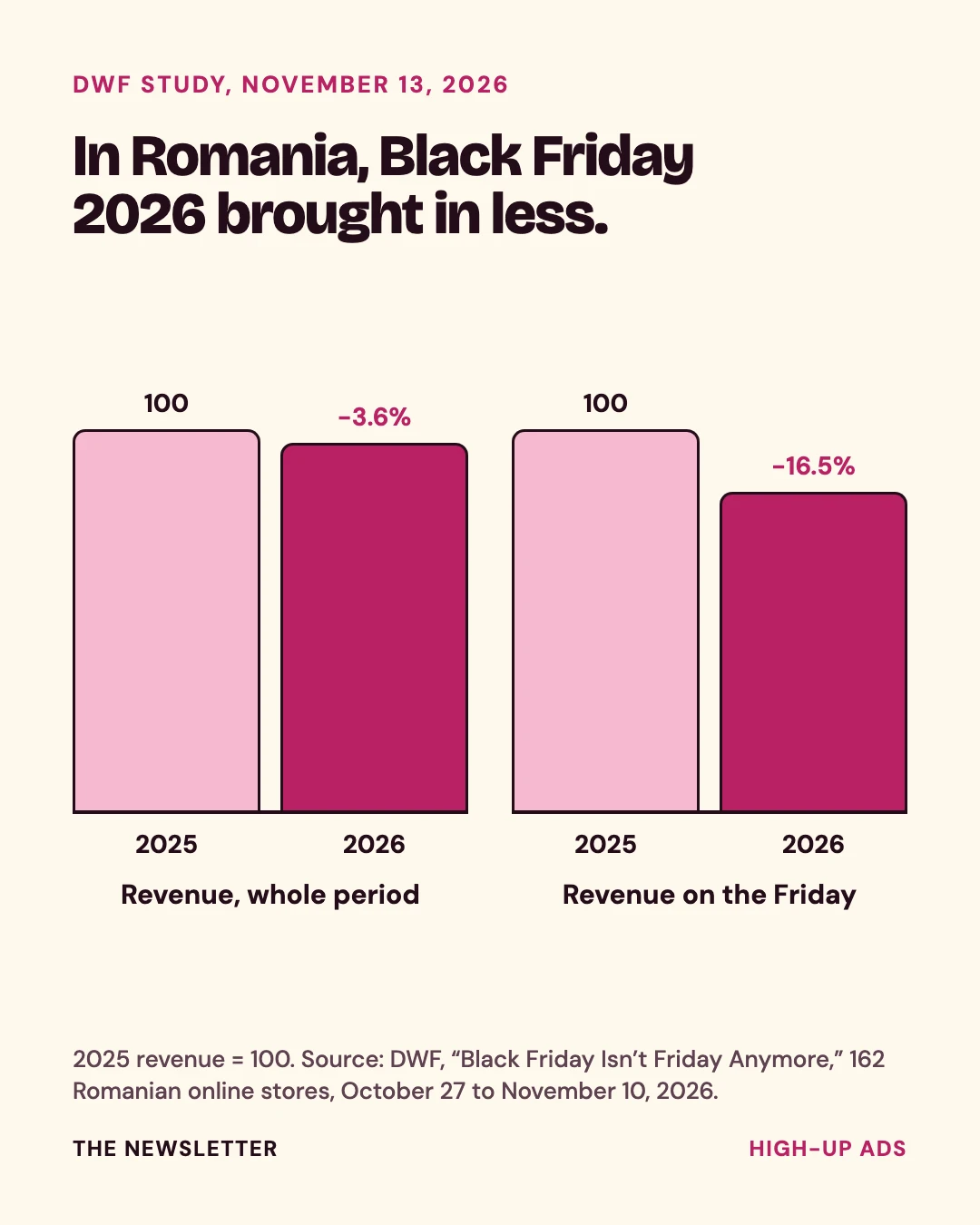
Romania, where our team works, gives you a look at where this goes. Black Friday runs about three weeks earlier there, and the numbers for 2026 are already in. On November 13, 2026, the agency DWF published data from 162 Romanian online stores (Google Analytics, October 27 to November 10, 2026). Revenue for the whole period was 3.6% lower than in 2025. Revenue on the Friday itself was 16.5% lower. The money moved to the days before, and one of the study's findings may sound familiar: more visits, fewer orders.
Customers get price-sensitive because you teach them to.
A lot of owners think price sensitivity comes with the market: "People around here only look at price." Research on real shopping data says otherwise.
Mela, Gupta, and Lehmann (1997, Journal of Marketing Research) tracked more than 8 years of real purchase data for a packaged good. Over that stretch, shoppers got more sensitive to price and to deals. And the shift lined up with two company decisions: more promotions and less advertising. The flip side is the interesting part. Advertising that isn't about price kept price sensitivity down.
In other words, the market isn't forcing you to discount. The way you market builds a market where you have to.
Lowe and colleagues (2014, Journal of Product & Brand Management) show how it happens: after repeated promotions, the price people expect drops. If you sell a face cream for $100 and put it at $70 five times a year, $70 becomes its real price in your customer's head. The $100 starts to look like a trick.
And Pauwels, Hanssens, and Siddarth (2002, Journal of Marketing Research) measured what a price promotion leaves behind in the long run: how often people buy in the category, which brand they pick, how much they buy. The permanent effect is practically zero.
In short, a discount brings you sales the week it runs. It doesn't bring you new customers for good.
Keep in mind that all three studies looked at everyday packaged goods, not services. The mechanism still applies to a salon, a clinic, or a repair shop, because people learn when to come in and what to pay. The numbers just don't carry over one to one.
One more number, so you know what you're up against. Nielsen analyzed more than 1 million products and 39 million promotions in the US and found that about three quarters of the promotions don't break even (reported October 9, 2014; there's no public update).
Three out of four. So the question isn't whether your promotions sold. Of course they sold. The question is whether they made money.
Run the numbers on your last promotion by margin, not by sales.
This is step one, and the only one we'd ask you to do this week. Take your last promotion, maybe last year's Black Friday sale, and do some simple math.
The margin you made on the extra sales, minus the margin you gave up on sales you'd have made anyway at full price.
Let's run it on a made-up example with round numbers.
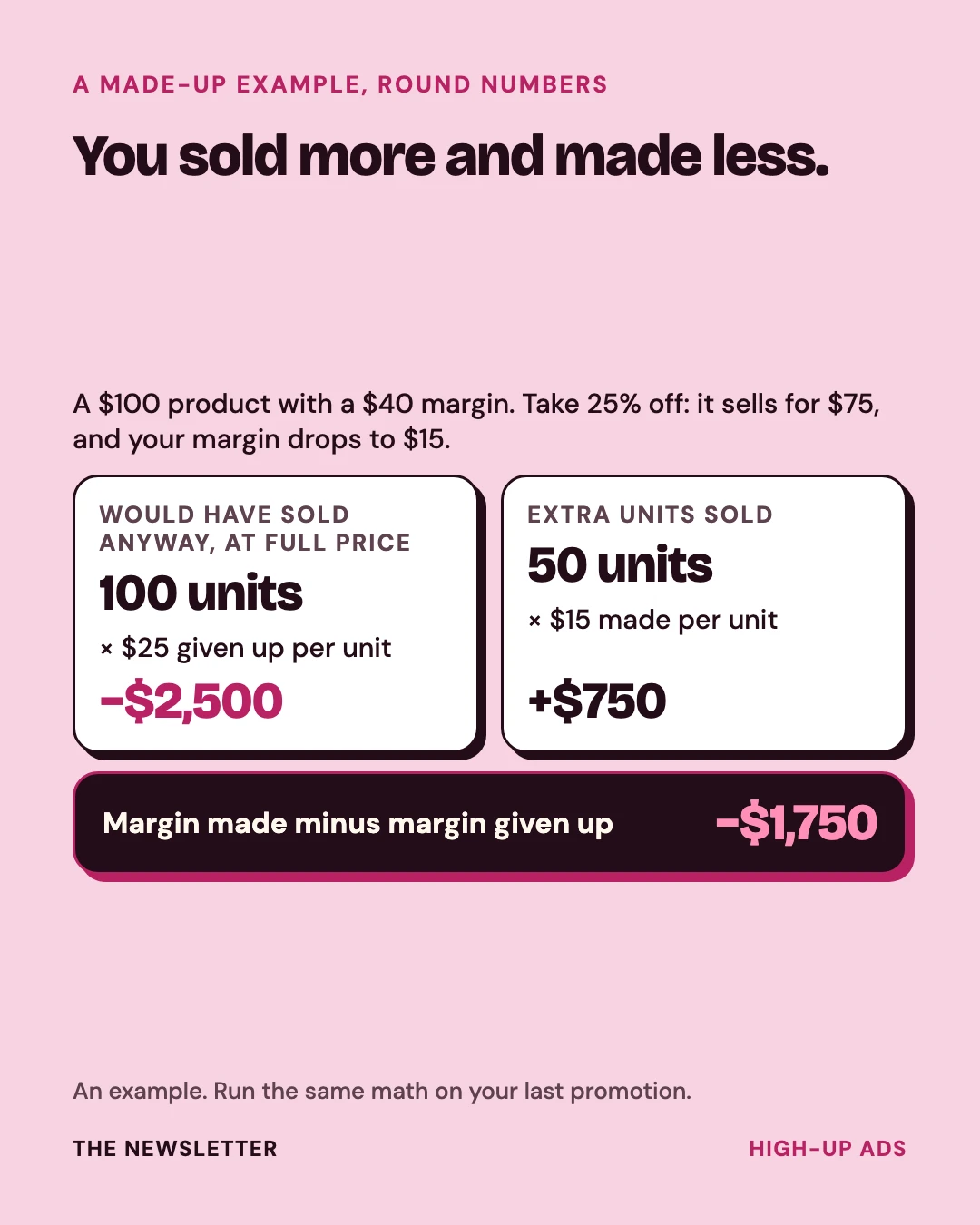
Say you sell a product for $100. Your margin is $40 a unit. In a normal month you sell 100 units.
You take 25% off. The product now costs $75, and your margin drops to $15. You sell 150 units. Looks like a win: sales went from $10,000 to $11,250.
Now the real math.
The 50 extra units brought in 50 × $15 = $750 in margin.
But 100 of those 150 units would have sold anyway, at full price. You gave up $25 on each of them. That's 100 × $25 = $2,500 in lost margin.
The promotion's result: $750 minus $2,500, which is a loss of $1,750.
You sold more and made less. To break even, you'd have needed 167 extra units, or 267 in total, not 150.
The hard part is figuring out how many units would have sold anyway. You don't need lab precision. Look at a normal month with no promotion. Look at the same stretch last year. And look at the weeks after the promotion: if sales dip below normal, some customers just bought early what they'd have bought anyway.
Services work the same way. Count the appointments from the promotion week and compare them to a normal week. How many were regulars who would've come in anyway?
If the result is negative, there's no shame in it. Nearly three quarters of the promotions Nielsen looked at came out the same way.
Give more product instead of cutting the price.
Step two: move the promotion from price to quantity or a bonus. The price stays the one you want people to remember.
Chen, Marmorstein, Tsiros, and Rao (2012, Journal of Marketing) showed something you probably sense already: people are bad at percentages. A bonus pack ("50% more") beat an equivalent 33% off, even though the price per unit comes out the same. In a field experiment in a store, the bonus pack sold substantially more than the discount.
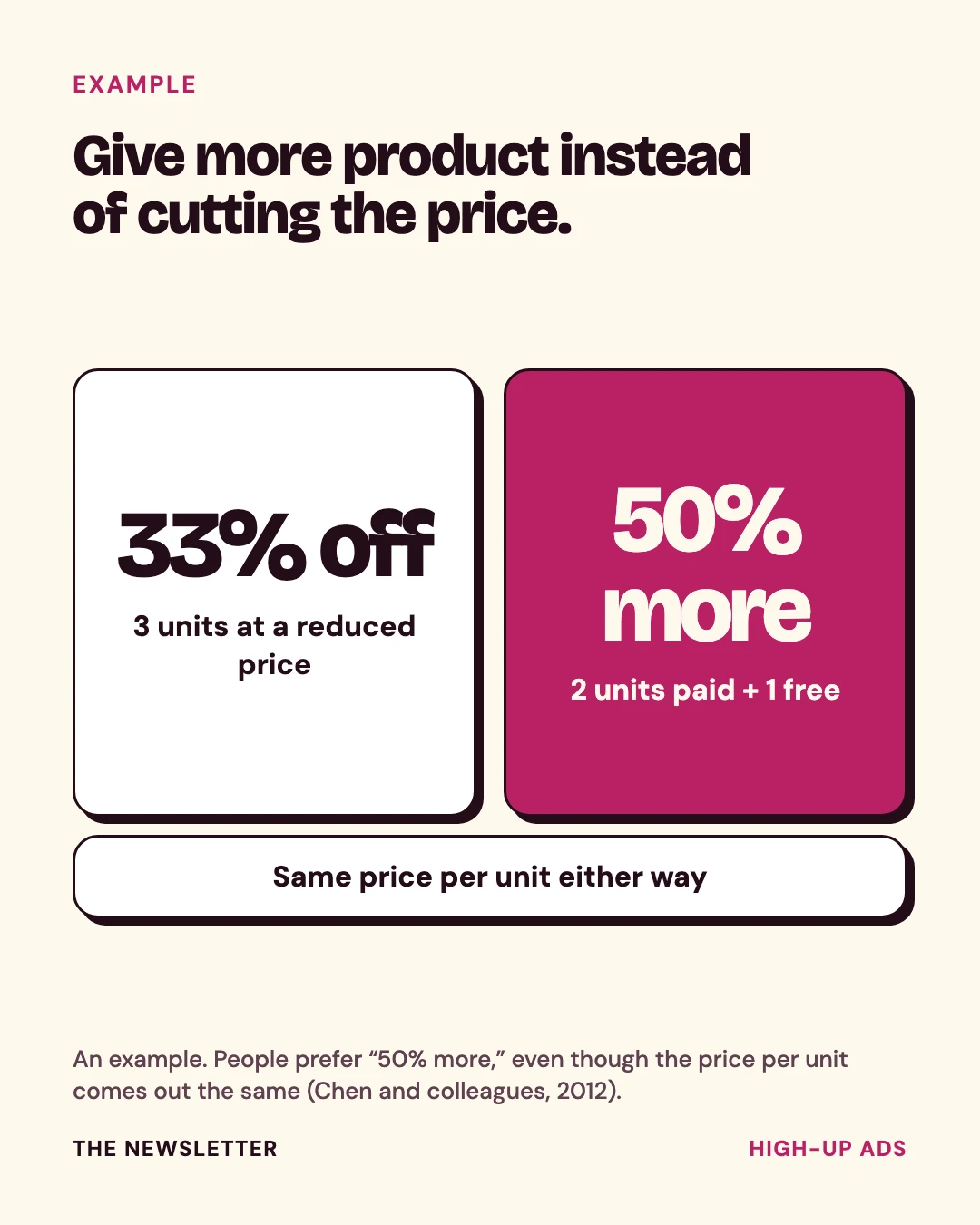
For you, the difference is big. With the discount, customers learn the product costs less. With the bonus, they learn they got something extra at the regular price.
What the bonus can be depends on your business.
At an online store: free shipping, a small product in the box, an extended warranty.
At a salon: a short extra treatment with the main service.
At a clinic or a repair shop: an extra check included in the same visit.
On bigger-ticket items you have one more option: interest-free installments. Shoppers already use them a lot. In the US, people spent $10.1 billion online with buy now, pay later from November 1 to December 1, 2025, up 9% from a year earlier (Adobe). For the customer, installments do the job a discount does: they make it easier to buy now. For you, the price doesn't move. The installment provider does charge you a fee, so compare it with what a discount would cost you.
Ease off discounts gradually. Don't cut them overnight.
This is the trap people fall into once they're sold on the idea and rush.
In 2012, J.C. Penney's then-CEO, Ron Johnson, dropped most of the coupons and sales events and switched to everyday prices he called "fair and square." It made sense on paper.
The result for fiscal 2012: comparable store sales fell 25.2%, and total sales fell 24.8% to $12.985 billion, the lowest since 1987. The company lost $985 million. The coupons came back.
The lesson isn't "never give up discounts." It's "don't suddenly break a habit you spent years building." Penney's customers had been trained to come in for the coupon. When the coupon disappeared and nothing else of value took its place, they left.
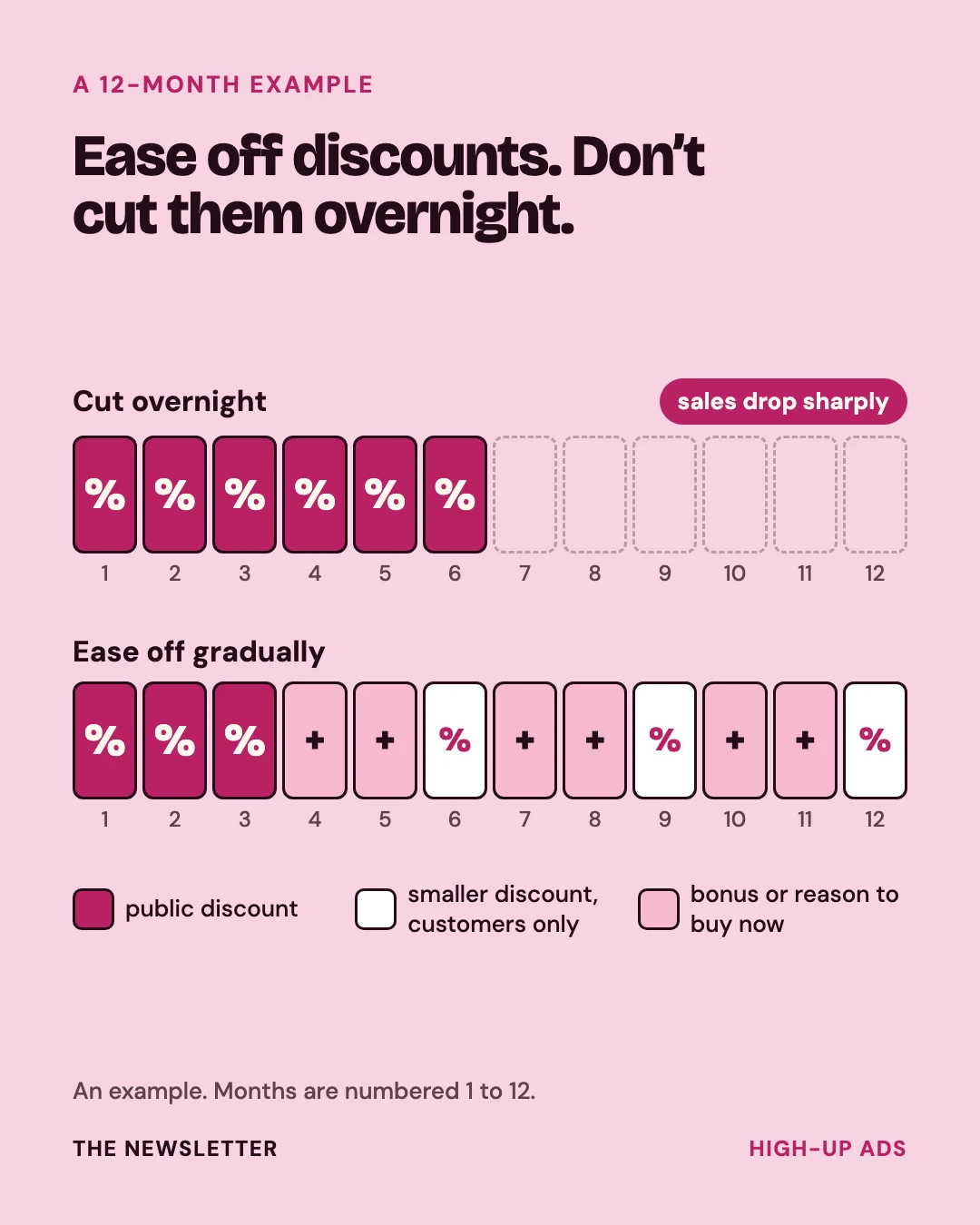
So, step three: ease off, don't cut.
If you run a discount every month now, go to once a quarter. Make it smaller than the one your customers are used to. And stop announcing it publicly, on your site and in your ads. Send it only to existing customers, by email or text.
That way the people who already buy from you keep a reason to stay, and everyone else doesn't learn that your real price is the sale price.
Give people a reason to buy now that isn't price.
A discount does one thing well: it gives people a reason to stop putting it off. Take it away and you need another reason in its place. That's step four.
A few that don't touch the price.
A seasonal edition or package. Something that exists only in winter, only for the holidays, only until the end of the month.
Stock that's genuinely limited. The key word is genuinely: if you write "only a few left" and a month later there are still only a few left, people learn not to believe you.
An open slot on the schedule. For services, it's the most honest reason to act now: "We have an opening Thursday at 4 pm." It's true, it's specific, and it costs you nothing in margin.
Step five goes hand in hand with this one. Put part of your discount budget into explaining why you charge what you charge: the materials you use, how long the job takes, what you check before you hand back the car, the warranty you give. That's exactly the kind of advertising that went with lower price sensitivity in the Mela, Gupta, and Lehmann study.
Think of it this way. If you skip a 25% discount for a month, that money doesn't disappear. Part of it can go into messages that show people what they get for the full price. We wrote more about this in our issue on why someone would choose you when you sell the same product as everyone else.
And step six we've already covered: on bigger-ticket items, offer interest-free installments instead of a discount.
Six mistakes that keep customers waiting for the sale.
We see them all the time, at online stores, salons, clinics, and repair shops. They usually show up in this order.
One: you run public discounts every month. Customers have no reason to buy on day 1 when they know the deal comes on day 20.
Two: you discount everything storewide. Products that would have sold at full price anyway end up selling cheap, and that's where you lose the most money.
Three: you judge the promotion by total sales. Sales almost always go up. The question is what happened to your margin on what would have sold anyway, the math from step one.
Four: you announce a "last chance" three times a year. The first time, people believe you. By the third, they've learned the last chance comes back.
Five, and this one's for services: "Discount Tuesdays." It looks like a smart way to fill a slow day. In practice, it teaches customers to come in only on Tuesdays. The other days don't fill up, and you sell Tuesdays for less.
Six comes after all the others: when you see the discounts aren't making money anymore, you cut everything at once. Exactly what J.C. Penney did in 2012.
If you saw yourself in three or four of these, don't start with all of them. Start with the math on your last promotion. The other steps make sense only once you've seen that number.
If you'd like to do it together, in our free audit with Oana (an hour on Zoom or Google Meet) we can take your last promotion and run the margin math on it, line by line.
Until then, there's just one question we'd ask you to take with you this week.
- Adobe: Cyber Monday 2025 results, with Black Friday, Cyber Week, and buy now, pay later figures
- BCG: Consumers are rewriting the rules of year-end sales (November 2025)
- DWF study via Wall-Street.ro: Black Friday 2026 in Romanian online stores (in Romanian)
- Duke Scholars: Mela, Gupta, and Lehmann, Journal of Marketing Research (1997)
- Emerald: Lowe and colleagues on price promotions and reference prices (2014)
- Marketing & Metrics: Pauwels, Hanssens, and Siddarth on the long-term effects of price promotions (2002)
- FoodNavigator: Nielsen finds three quarters of CPG promotions don't break even (2014)
- University of Minnesota: Chen, Marmorstein, Tsiros, and Rao, Journal of Marketing (2012)
- JCK: J.C. Penney lost nearly $1 billion in 2012
- HIGH-UP ADS: Your competitor sells it for less. What to put next to the product instead of cutting your price




Written by the HIGH-UP ADS team: Oana, Lorena, Marian, and Stefan.