

Your business is doing fine. It's been around a few years, it has customers, it has a team. At the end of the month you look at sales, you look at what a click cost you, and if the numbers look fine, you move on.
Except it's not growing the way it used to. And it's not clear why.
Of the US business locations that opened in the year ending March 2021, 79.1% were still open a year later. By March 2026, five years in, only 47.2% were (Bureau of Labor Statistics).
The government counts how many close. Nobody publicly tracks why.
What we can tell you is what we see when we look inside businesses that are doing fine but have stopped growing. The lessons owners learn too late have one thing in common: they measure what's easy to see, and what's hard to see breaks down slowly, for years.
Below are five of those things, plus six checks you can do on your own. Two of them take one evening.
Let's start.
The report shows what sold this month, not what stopped three months ago.
A report tells you what happened. It doesn't tell you what stopped happening.
A short example from our own work. At a professional cosmetics store in Romania, the Facebook pixel (the code that tells Facebook what people do on your site) had been taken off the site. The last signal came in March, and we took over the account in June. For three months, the platform had no way of knowing who was buying. The owner never saw that in any report.
We told the whole story in our issue about the account that counted sales that didn't exist.
Nobody got it wrong on purpose. Nobody was looking there, that's all.
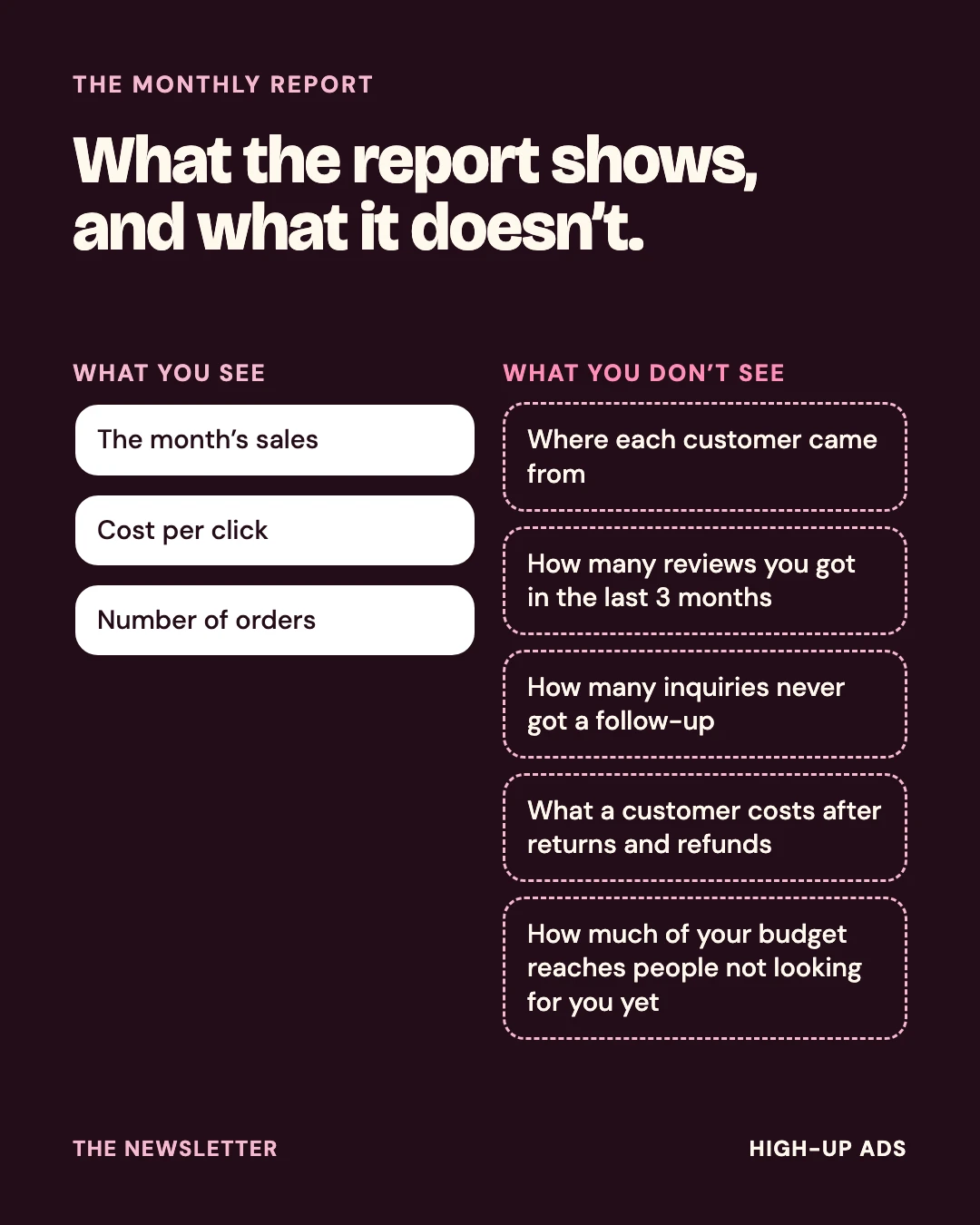
Each item in the right-hand column gets its own section below.
If you answer everything yourself, the business only answers when you have time.
You answer the messages. You approve the quotes. You know the prices, you know when there's an opening. For years that was an advantage: customers talked straight to the owner.
The trouble starts when the business grows and there's still only one of you. When you're with a customer, at the bank, or driving, the messages sit there and wait for you. Your company's response time ends up depending on your schedule.
Small businesses aren't the only ones. In a 2011 Harvard Business Review audit of 2,241 US companies, only 37% answered an inquiry within the first hour. 24% took more than 24 hours, and 23% never answered at all.
What happens to an inquiry after someone hits submit is a story we told in our issue on inquiries that get lost after the form. Here we care about something else: how many of them are waiting on you.
Two checks.
Step 1. Open your phone: texts, DMs, email. Find the inquiries from the last 30 days that you answered once and never followed up on. The person asked, you answered once, then they went quiet and so did you. Count them.
Step 2. The "if I'm gone for a week" test. Take a sheet of paper and write down what would stop at your business if you didn't answer for 7 days. Quotes? Appointments? Paying suppliers? Replying to reviews?
Everything on that list is a place where your business loses customers while you're busy. Not just when you're away.
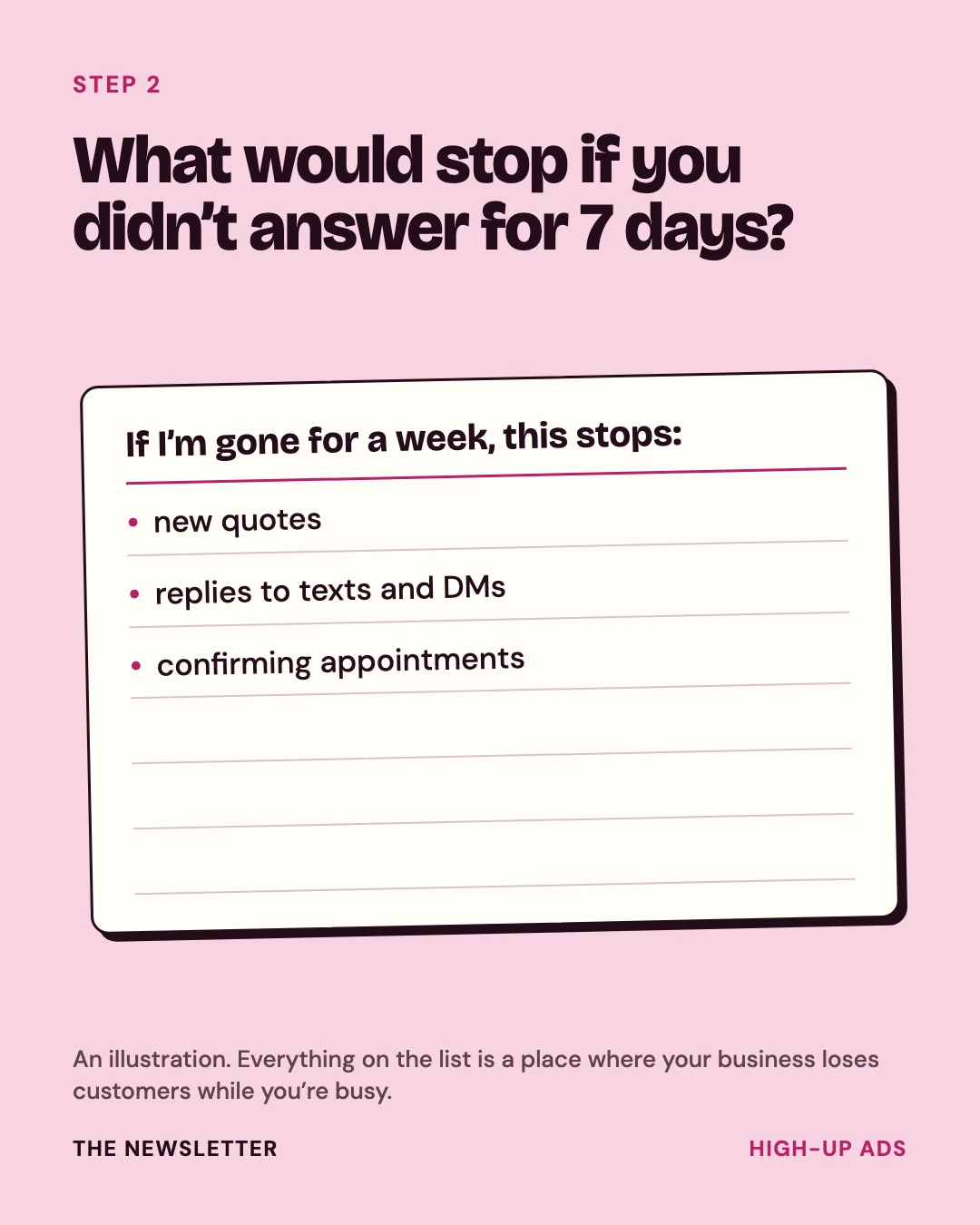
Answering yourself is fine. Being the only person who ever answers is the mistake.
Reviews get old, even when your rating stays the same.
Say you have 300 Google reviews and a good rating. But most of them are from 2022, and only a handful have come in since.
To you, those 300 reviews prove you do good work. To a new customer who's seeing you for the first time, you look like a business that's winding down.
BrightLocal surveys American consumers about reviews every year. In its 2026 survey of 1,002 US adults, published February 11, 2026, 74% said they only pay attention to reviews from the last 3 months. 32% look for reviews from the last two weeks, up from 20% in 2025. 47% won't use a business with fewer than 20 reviews. And 68% only use businesses rated 4 stars or higher, up from 55% in 2025.
Then there's the part few owners look at: the reply. In the same survey, 89% expect the owner to respond to reviews, and 50% are unlikely to pick a business whose replies look like a template. 19% want a reply the same day, up from 6% a year earlier.
So a "Thank you so much!" pasted under every review tells people nobody read theirs.
We see two mistakes over and over. You ask for reviews when the business is new, then stop. And you answer every one with the same "Thank you so much!", or you don't answer at all.
Step 3. Open your Google Business Profile. Count the reviews from the last 3 months. Then count how many got a reply written for that person, with their name and what they actually said, not a pasted "Thank you so much!"
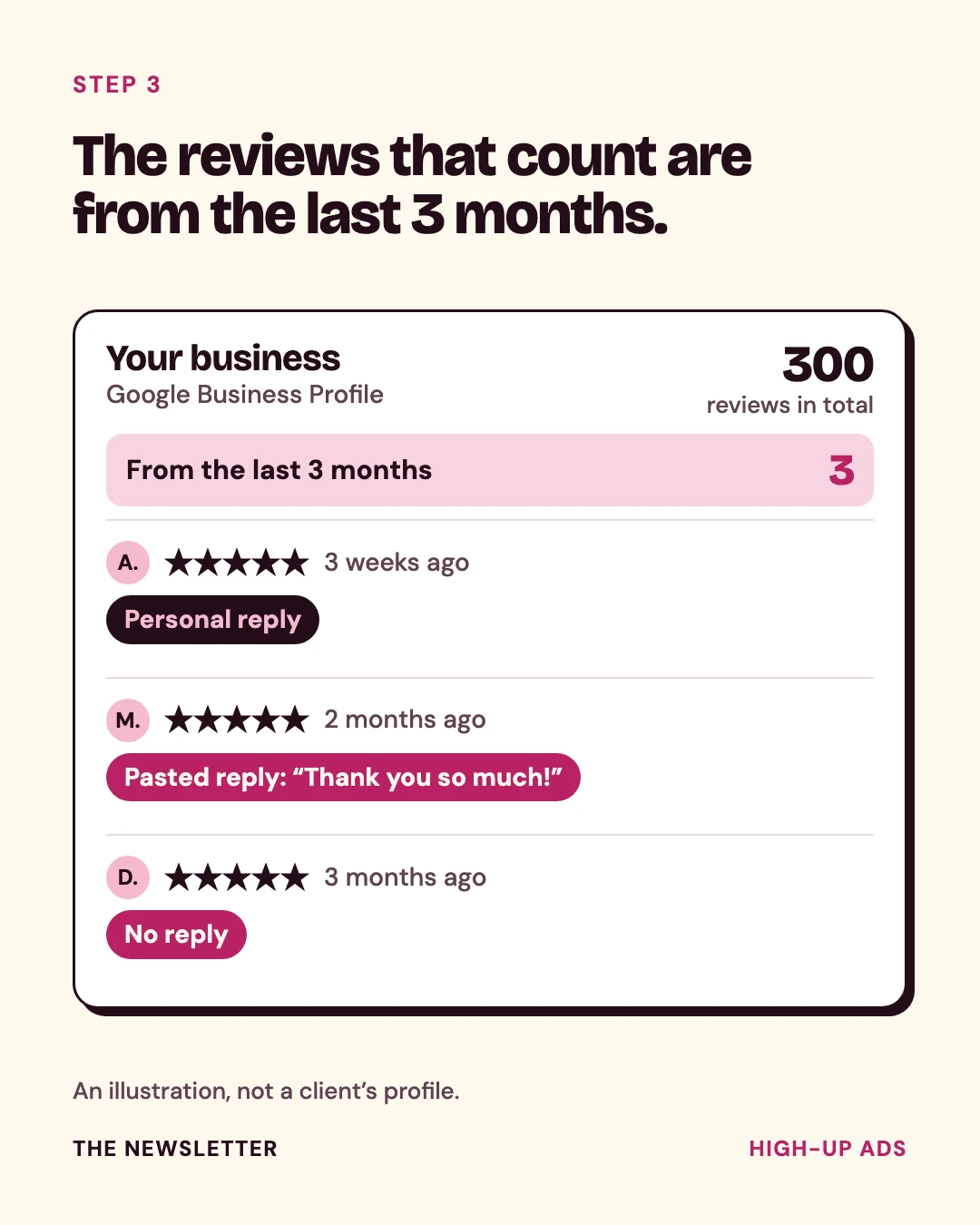
If your last-3-months number is small, your overall rating isn't protecting you anymore.
If one channel brings in most of your customers, you won't notice it shifting until inquiries drop.
You probably know which channel brings in most of your customers. You probably haven't counted.
That matters because the places people look for businesses move, and they move fast. In the same BrightLocal 2026 survey, Google as a place to read reviews fell from 83% to 71% in one year. And the share of people using AI tools to find local businesses jumped from 6% to 45%.
A business that depends on one channel, usually Facebook and Instagram or Google Maps, doesn't see that shift in a report. It sees it when inquiries drop.
Step 4. Take your last 20 to 30 customers and write next to each one where they came from: Google, Facebook, Instagram, a referral, they drove past. If more than half came from one channel, that's your biggest risk.
That doesn't mean you should drop it. It means you've put a lot of eggs in one basket, and you'd better know that before the basket tips over.
Cost per order isn't the cost of a customer who actually paid.
We see this one mostly with online stores.
In the ad platform you see what an order cost you and how many dollars came back for every dollar you spent on ads. It looks good. But not every order turns into money you keep.
US retailers expected 19.3% of online sales to come back as returns in 2025 (NRF and Happy Returns, October 2025). A return can cost you shipping both ways, and none of that shows up in the ROAS Meta reports.
The mistake is simple: you work out cost per order, not cost per paying customer after returns and refunds.
Step 5. Add up everything you spent to bring in customers over one period: ads, fees, returns, refunds. Divide it by the number of new customers from that same period. That's what a new customer really costs you.
Then put it next to what a customer brings in during their first year. If the two numbers are too close, you just learned something the monthly report would never have told you.
For a salon, an auto shop, or a clinic, the math is the same, even without returns. You have no-shows, and you have quotes that never close.
Spending only on people who buy today looks efficient for years, then gets expensive.
The last one is the hardest to see, because for years it looks like a smart decision.
When the budget is small, it's natural to put it all on "buy now": people already searching for you, people who've been on your site, people who left something in their cart. Clicks are cheap and the money comes back fast.
Les Binet has spent decades studying what makes advertising pay off, and he explains why that works and why it doesn't last. In research he and Will Davis published with the IPA, the UK advertising industry's trade body, in October 2025, tight targeting made ads more efficient and a lot less effective. In the IPA Databank, the trade body's collection of effectiveness case studies, return on investment has gone up 4% since Covid, while net profit is down 11%. Taken too far, tight targeting can end in what Binet calls a "death spiral": budgets, campaigns, and profits that keep getting smaller. Back in 2018, Binet was already saying digital had pushed consumer brands too far toward short-term sales.
Why does that happen? John Dawes of the Ehrenberg-Bass Institute has a model called 95:5 (2021), built for businesses that sell to other businesses. The idea is that at any given moment, only about 5% of buyers are "in market," meaning ready to buy now. It's a rule of thumb, not a law of nature. As a way to look at your budget, though, it helps.
If your whole budget goes to the few who are searching today, you only sell to them. Everyone else, the people who'll be searching six months or two years from now, doesn't know you when they start looking. So when that day comes, they pick someone else.
The efficiency looks great for years. Then the cost per customer climbs, and nobody can tell why.
This mistake comes with a line we hear a lot: "We'll worry about branding when we have the money." Meanwhile, the whole budget goes to people who already know to look for you.
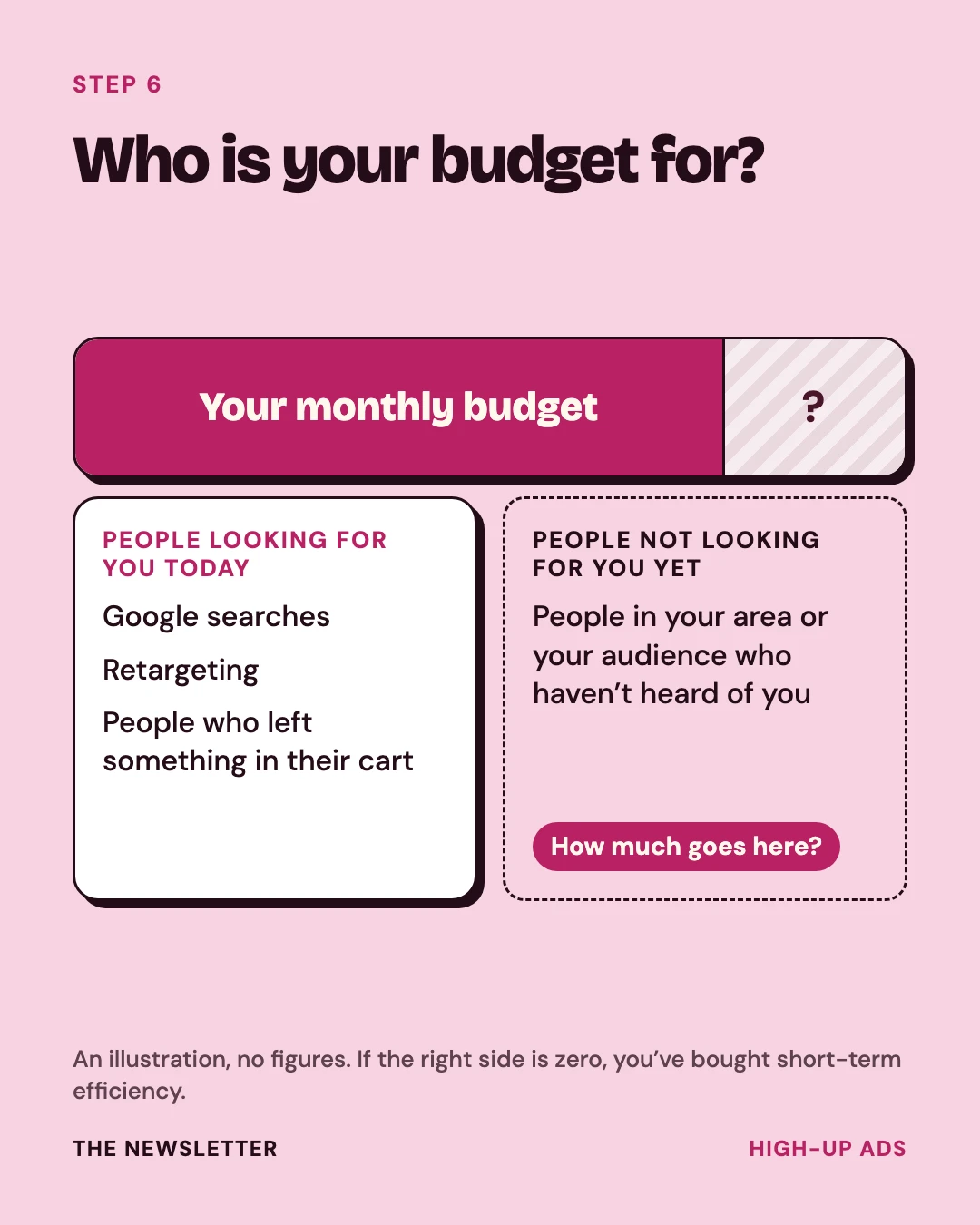
Step 6. Look at how much of your budget reaches people who aren't looking for you today. If it's zero, you've bought short-term efficiency.
This week, do the two counts that fit in one evening.
Six steps is a lot at once. You don't have to do them all now.
Start with two.
Count your reviews from the last 3 months on your Google Business Profile, and how many got a reply written for that person. That tells you how you look to someone who finds you for the first time today.
Write your "if I'm gone for a week" sheet. What would stop at your business if you didn't answer for 7 days. That tells you how much depends on you alone.
Neither one needs a specialist. You need your phone, a sheet of paper, and one free evening.
The other four (where your last customers came from, what a customer really costs, inquiries that never got a follow-up, and the budget for people who aren't looking for you yet) you can do one at a time over the next few weeks.
If you'd rather go through them with someone, the free audit with Oana is an hour on Zoom or Google Meet, and we start from exactly these counts.
Until then, take one question with you.
- Bureau of Labor Statistics: Survival of private sector establishments by opening year
- Harvard Business Review: The Short Life of Online Sales Leads (2011)
- BrightLocal: Local Consumer Review Survey 2026
- NRF: Consumers expected to return nearly $850 billion in merchandise in 2025
- IPA: Go big or go home, Les Binet and Will Davis (October 2025)
- CMO Australia: Les Binet on digital and short-term sales (2018), archived copy
- Ehrenberg-Bass Institute: The 95:5 rule (John Dawes)
- HIGH-UP ADS: The Google account was counting sales that didn't exist
- HIGH-UP ADS: Plenty of leads, few signed jobs. Where are they going?




Written by the HIGH-UP ADS team: Oana, Lorena, Marian, and Stefan.