

You start the month fired up. One post a day, like everybody says you're "supposed to."
The first week goes fine. By the second, you're staying late after closing, hunting for a photo that's "nice" enough. In the third you skip a day, then two. Then a week full of customers hits, and the account goes quiet.
Two months later you stumble on it and tell yourself, "I'll get back to it next month."
If that sounds familiar, you've made the same mistake we see with a lot of owners. You figured that if you can't post every day, there's no point posting at all.
The data says the exact opposite. How much you post in a good week matters less. Whether you show up every week matters a lot more.
In this issue we'll walk you through a routine that fits into one Monday morning: what to film, where to put it, what to do every day in 2 minutes, and what not to do. No "pretty" photos. Just your phone.
The account that shows up every week beats the one that posts in bursts.
On January 29, 2025, Buffer (an app for scheduling social posts) published a study on consistency. It looked at more than 100,000 users over the previous 26 weeks, across all the big networks.
They grouped accounts by how consistently they posted. The most consistent accounts, the ones that posted in at least 20 of the 26 weeks, got 450% more engagement per post (the median) than the inconsistent ones, which posted in 4 weeks or fewer.
450%. That's not a typo.
Keep in mind that the study shows a link, not a cause. The consistent accounts may have had other things in common, too. But the author's takeaway is simple and easy to act on. Ideally, post at least once a week. Skipping a week now and then is fine.
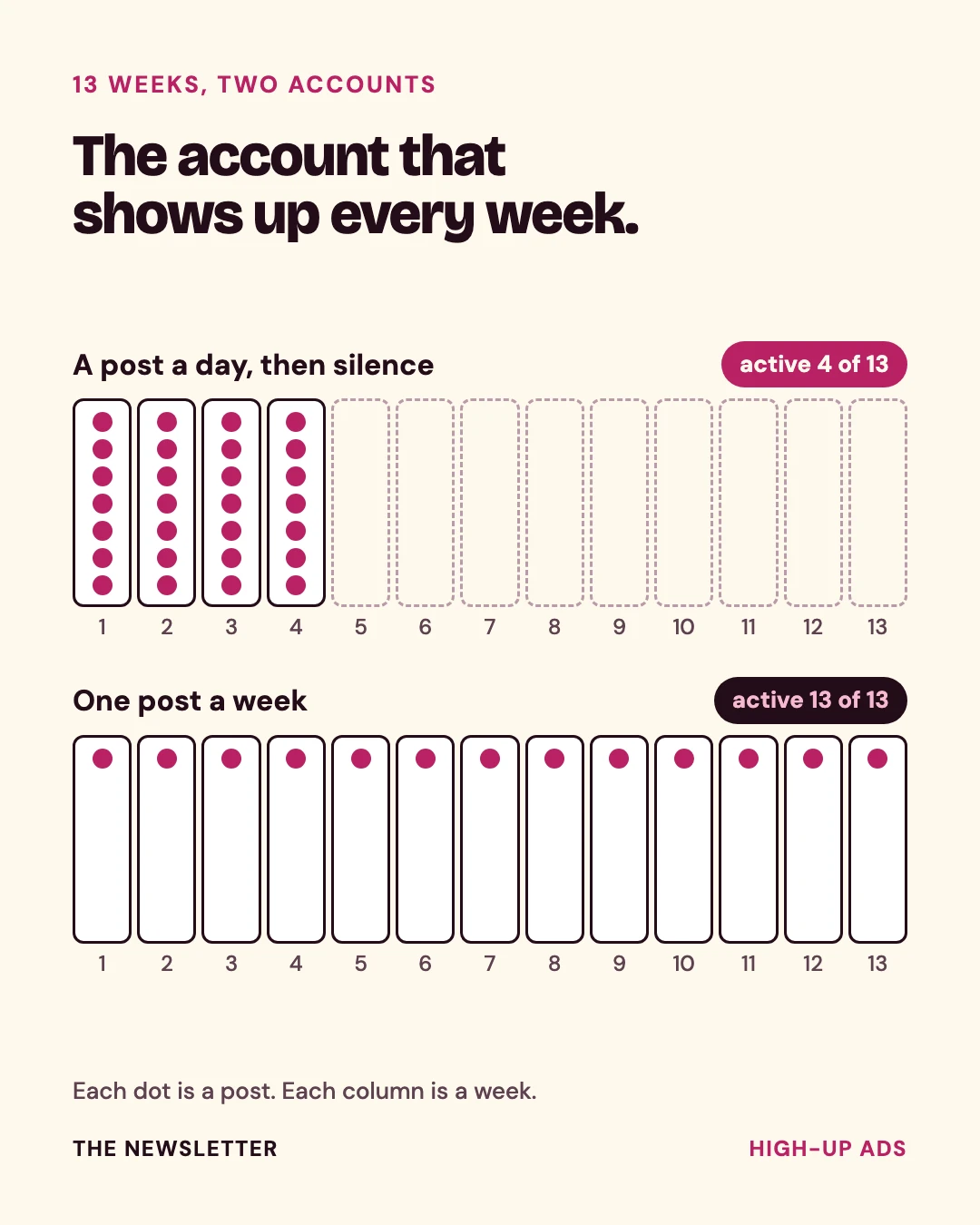
Now go back to the scenario at the top. One month with 30 posts, then two months of silence. On paper, that's a lot of work, and it was. On the calendar, though, the account was active about one week out of three.
An account that posts once a week without a break was active every single week. With a lot less work.
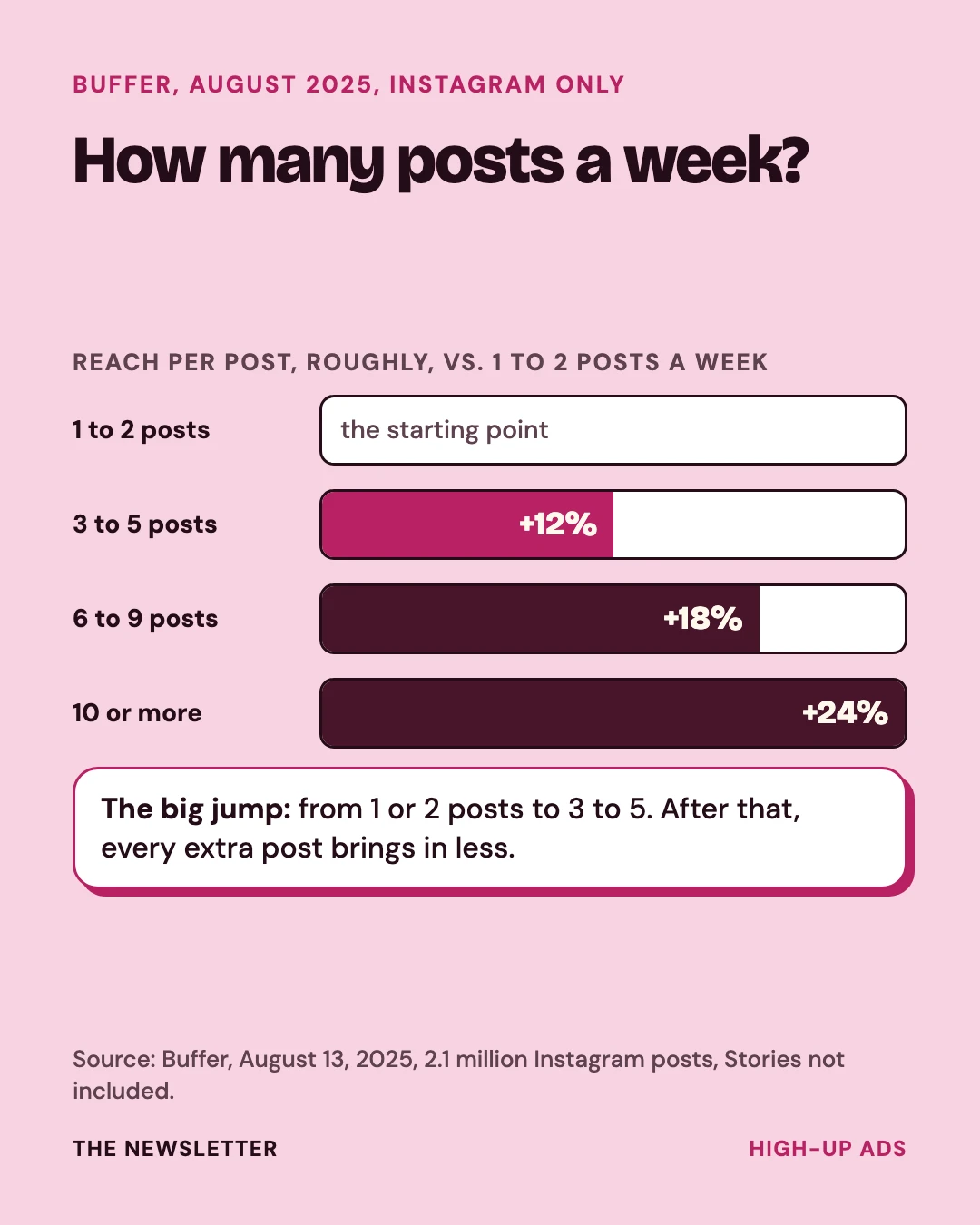
On Instagram, the big jump comes when you go from 1 or 2 posts a week to 3 to 5.
OK, so how many posts a week? Here we only have data for Instagram. Keep that in mind: what follows wasn't measured on Facebook or TikTok.
On August 13, 2025, Buffer published a second study, this time just on Instagram: 2.1 million posts from about 102,000 accounts, not counting Stories. It compared what happens at different posting rates, starting from 1 to 2 posts a week.
Going to 3 to 5 posts a week doubles follower growth: +0.26% versus +0.12%. And each post reaches about 12% more people.
At 6 to 9 posts a week, the gap grows to about 18%. At 10 or more, it's about 24%.
In practice, two or three extra posts a week get you about 12%. The next 6 points take about four more posts a week. The 6 after that take even more. Every extra post brings in less than the one before, and it costs you just as much time.
There's one more finding in the study, and it may matter most for you. Weeks with zero posts fell below the account's usual growth. A break doesn't keep you where you are. It sets you back.
Buffer recommends 3 to 5 posts a week. It also says, "The best posting schedule is one you can stick to consistently." That's the sentence to build your routine on.
So: three posts a week, every week. Let's see how you get them done without giving up your evenings.
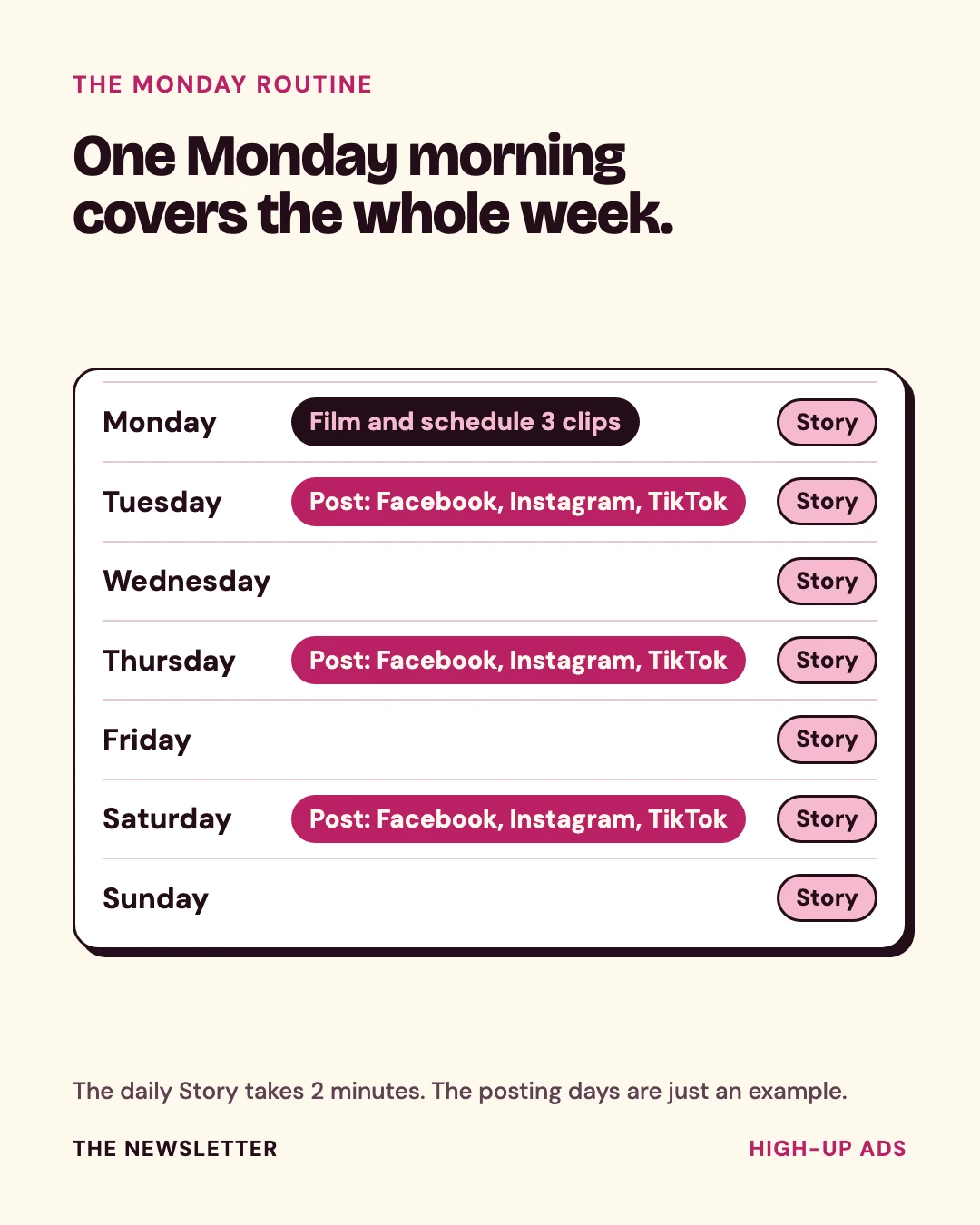
On Monday, you film three short clips of real work in 60 to 90 minutes.
Open your calendar now and block 60 to 90 minutes next Monday. Not "when I get a chance," but a slot with a start time, like a customer appointment.
In that slot, use your phone to film three short clips of what you actually do at work. Don't make them "pretty." Make them real. People looking for you want to see how you work, not a catalog shot.
What you film depends on the business.
At a salon, film the before and after. The client sitting down in the chair and the client walking out, with her OK. That's a clip right there.
At a repair shop, film the old part next to the new one. Hold them both up and explain in a few sentences why the first one had to go.
That clip has a number behind it. In a September 2016 AAA phone survey of 1,001 US drivers, 63% said they generally don't trust auto repair shops, and the top reason (76%) was being recommended services they didn't need. A clip with the old part next to the new one answers exactly that, and it's seen by people who haven't walked into your shop yet. And the one doing the explaining is the owner.
At a clinic, a contractor, or anywhere else, pick a question customers ask you a lot and answer it yourself, on camera. "How long does it take?" "Why does this option cost more?" "What do I do afterward?" You hear them every week, so each one can be a clip.
And if you're wondering where you'll get ideas week after week, you don't have to go looking. You already have them. Look at what you worked on in the last few days. How to tie it all back to what you want people to know about your business is something we covered in our issue on becoming the name people search for.
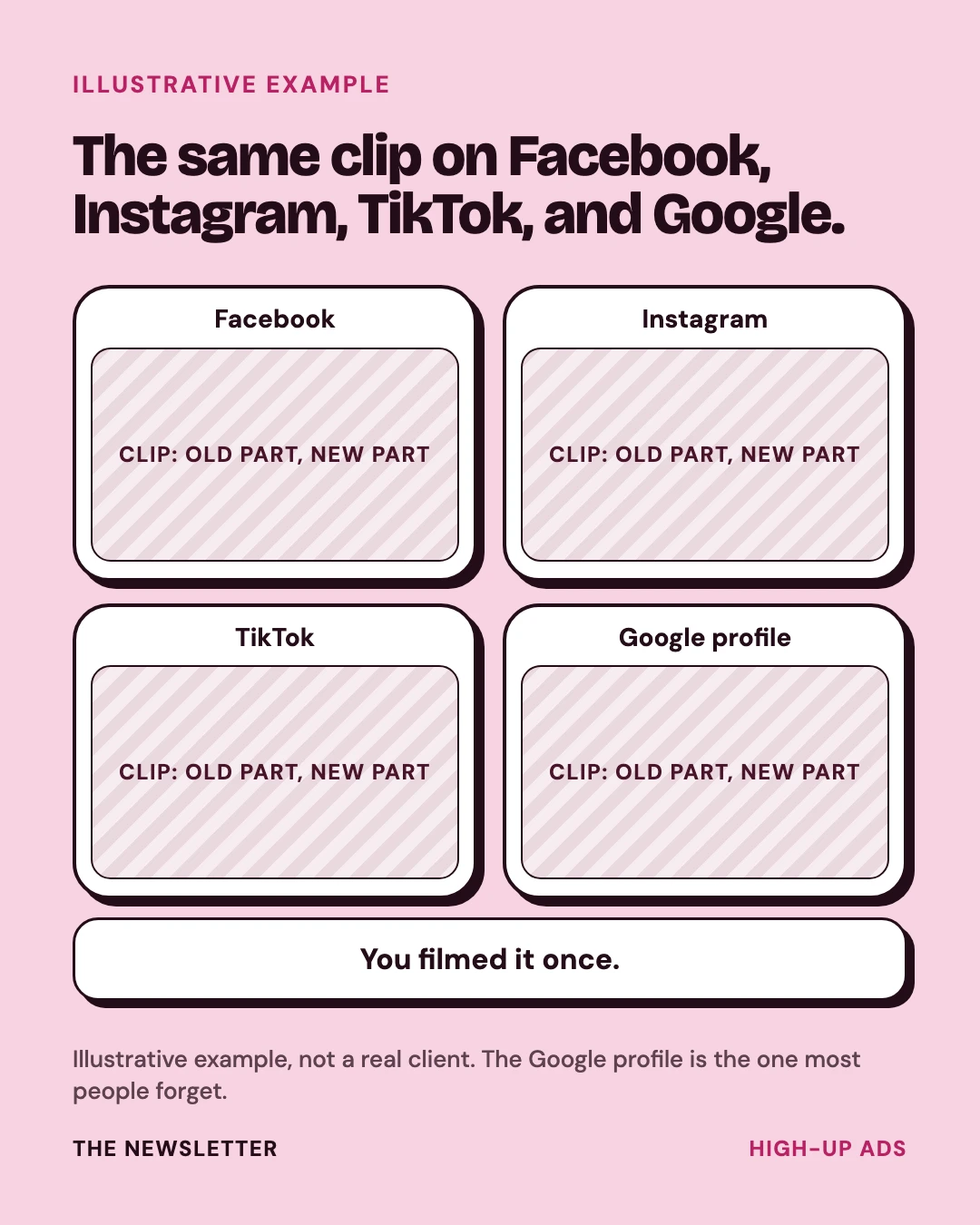
The same clip goes on Facebook, Instagram, TikTok, and your Google profile.
Still on Monday, while the clips are fresh on your phone, schedule them. In Meta Business Suite, you set up all three posts for Facebook and Instagram at once, say for Tuesday, Thursday, and Saturday. Then you upload the same clips to TikTok.
You filmed once and posted on three networks.
Then take the step almost nobody takes: upload the same photos and clips to your Google Business Profile. Google itself recommends adding photos and videos to your Business Profile.
Why does that matter so much? For a local business, the most important "post" often lives there, not on Instagram. On your Google profile, someone looking for a repair shop or a salon nearby looks at the photos and decides whether to call you. One old-part, new-part clip there can be worth more than ten posts nobody sees.
Which network should you lean on? Here are the US numbers from DataReportal's Digital 2026 report (data from October 2025). Facebook ads can reach 198 million people (up 2.5% in a year), which DataReportal puts at 71.4% of US adults. TikTok ads can reach 153 million adults (up 11.0%). Instagram ads can reach 182 million people (up 9.7%), and by DataReportal's count, 64.1% of US adults use it.
Be careful with what these numbers mean. They show the audience ads can reach, not how many people use each network every month. On top of that, Meta has revised its data. They're good for comparing the networks with each other, not as an exact head count.
Facebook reaches the most people, so if you run a repair shop, start there. If you run a salon, start with Instagram and Facebook. And whatever the business, don't skip the Google profile.
One thing to know about reusing content: it's only safe when it's your own. Since 2022, Instagram has ranked original content above reposts. And since April 2026, accounts that repost too many of other people's photos and carousels can't be recommended anymore. Your own clips, shot in your own shop, can go anywhere.
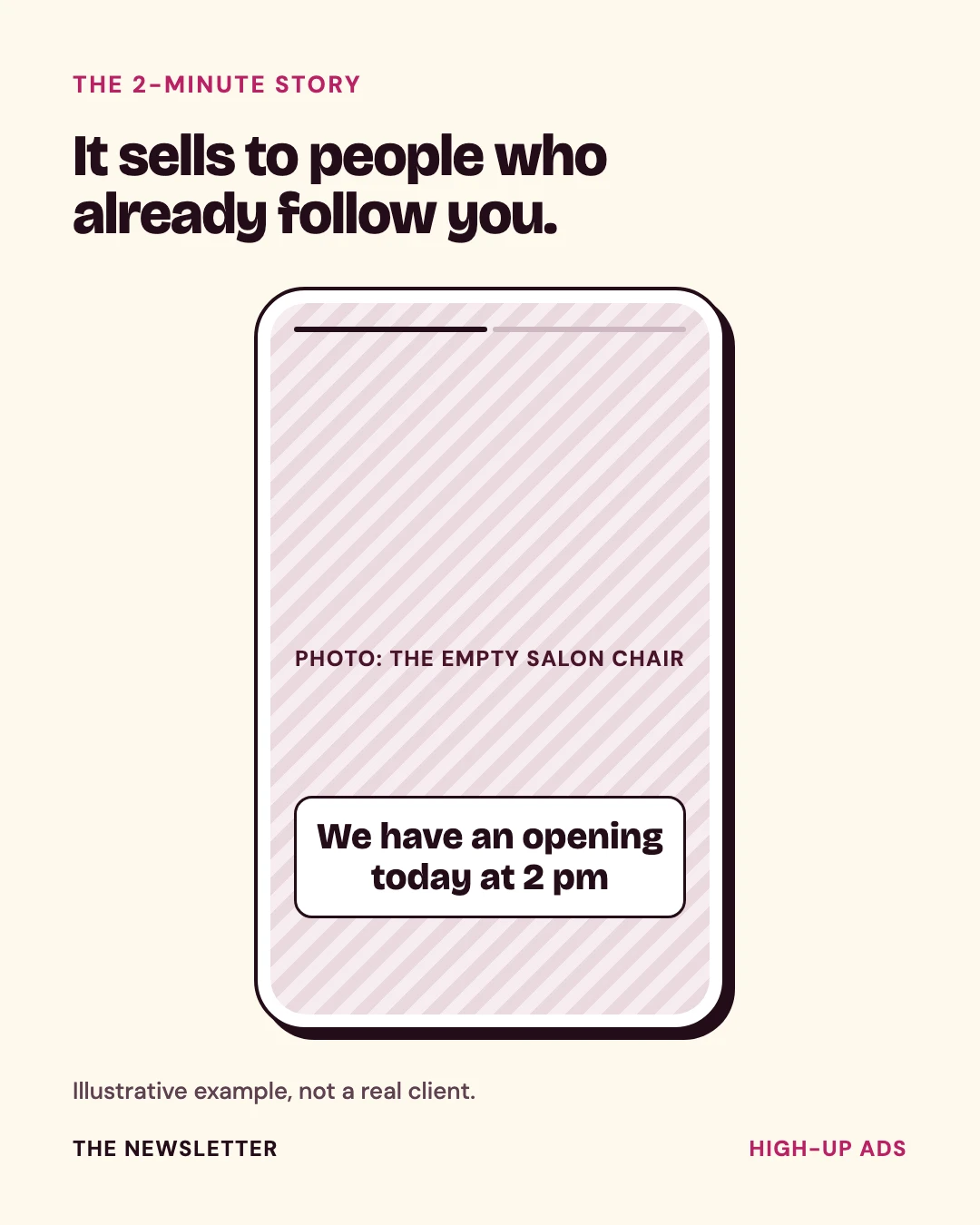
A 2-minute Story every day sells to the people who already follow you.
On top of the three posts, there's just one more habit, and it takes 2 minutes a day: one Story from your workday.
Say you run a salon and a slot opens up at 2 pm. Take a photo, write "We have an opening today at 2 pm," and you're done. At a repair shop, snap a photo of a car that's ready for pickup. Or share a review you got, with the OK of the customer who wrote it.
Stories have a clear job, and it helps to know what it is. They don't bring you new followers. They sell to the people who already follow you, like the person who's been meaning to come in and sees today that you have a 2 pm opening.
Also know that Stories don't count toward the three posts. Buffer's frequency study left them out. Posts bring in new people, and Stories bring in the ones who already follow you.
When the week is packed, post once and call it done.
There will be weeks when you can't film on Monday. A big client, an employee out sick, a job that runs long.
For those weeks there's one rule: post at least once. A clip, a photo from the shop, anything from real work. And never skip two weeks in a row.
Think of a packed week with one post as a week that keeps the account alive. It's not a lost week. Skipping one now and then is fine, and Buffer says so itself. Skipping two in a row is how the two months of silence start.
Six mistakes can undo your Monday work.
The first is where we started: posting every day for a month and then going quiet for two. It's more work than three posts a week, and it doesn't get you as far.
The second is reposting memes and other people's posts just to "have something up." Since April 2026, that's how you stop getting recommended on Instagram. And customers learn nothing about how you work.
The third is stock photos. Someone looking for a repair shop wants to see your shop, not a smiling mechanic from a stock photo site.
The fourth is posting nothing but promotions. If all anyone sees from you is "20% off," they get used to waiting for the deal. Clips of real work show them what they're paying full price for.
The fifth is putting nothing on your Google profile. You filmed, you posted on three networks, and you skipped the one place where the customer actually decides.
The sixth is thinking Stories bring in new followers and dropping posts because "I do a Story every day anyway." Stories sell to the people who already follow you. For new people to find you, you need posts.
And one rule that covers all of them: show real reviews and customers' faces only with their OK.
What did you work on this week that would've been worth 30 seconds of video?
Look back at the last five days. A car that came in with a problem and left fixed. A client who walked out looking different from when she came in. A question you heard three times.
You already had all of them. You just didn't film them.
If you'd like to pick the first three together, we can do that in the free audit with Oana, an hour on Zoom or Google Meet. The filming stays with you and your phone, though.
- Buffer: Consistent posting study (January 2025)
- Buffer: How often to post on Instagram (August 2025)
- AAA: Auto repair consumer survey (2016)
- Google Business Profile Help: Photos and videos on your Business Profile
- DataReportal: Digital 2026 United States of America
- TechCrunch: Instagram will prioritize original content over reposts (2022)
- Tubefilter: Instagram stops recommending accounts that repost too much (2026)
- HIGH-UP ADS: How do people start searching for you by name?




Written by the HIGH-UP ADS team: Oana, Lorena, Marian, and Stefan.