

"Most of our customers find us on Instagram."
Ever said that? Or one of its cousins: "It's mostly word of mouth," "Google doesn't really bring us anything," "Our regulars keep the lights on."
OK. Now the hard question. Did you count?
We're not asking if you know. We're asking if you counted. Sheet of paper in front of you, customer by customer.
If you didn't, you're in good company. You know exactly what you sell, what your materials cost, and which of your people do good work and which don't. But on where your customers come from, most of us go by feel. In a PYMNTS survey of 526 US small and midsize businesses (May 2026), 32% said they use informal observation, like talking with customers, to judge which channels bring in new customers, and 8% had no way of tracking it at all.
In an earlier issue, we covered what to ask an agency before you give it access to your accounts. Now it's your turn to bring something. A big part of what you get from an agency, from us or from anyone else, gets decided by the numbers you walk into the first meeting with.
Below is a sheet with six rows. You can fill in most of them this week, from your invoices and your appointment book. One of them takes four weeks.
Clients leave agencies over the work, and the work starts with your numbers.
Setup runs a survey every year on how brands and their agencies get along. The 6th edition came out on January 7, 2025, with more than 400 responses from both sides.
What came out of it:
48% of clients ended an agency relationship because they weren't happy with the work, up 14% from the year before.
"The agency didn't understand our business" went up 10 points from 2023, and it's now the No. 2 reason clients give for leaving.
Now the interesting part. Agencies rank that same reason dead last, 8th out of 8.
Wait, what?
Yep. The client says "they didn't get us," and the agency says "that's the least of it." Same relationship, two completely different stories. And 40% of clients say they plan to switch agencies in the next six months.
We're not saying agencies are off the hook. They're not, and we've written about that too. But nobody can understand your business without its numbers. If all you bring is "I want more customers," you get what can be built on that sentence: ads that bring in "something," reports full of clicks, and, sooner or later, the breakup from the survey.
Now Google is asking you for the same numbers.
Until recently, "bring us your numbers" sounded like something agencies say to cover themselves. Well, now Google says it too, in writing.
In its official guide to Performance Max campaigns for leads (the kind where Google decides on its own where your ad shows up), Google recommends two things.
First, give the system lead scores or the predicted lifetime value of a customer. In other words, tell it which leads turned out to be good and what a customer was worth, not just that someone showed up.
Second, pick the goal closest to a sale or a closed deal, one with at least 15 conversions in the last 30 days.
In plain English, the algorithm learns from whatever you tell it counts as a win. Tell it a filled-out form is a win, and it learns to bring you forms. Not customers. Forms.
And forms don't pay the bills.
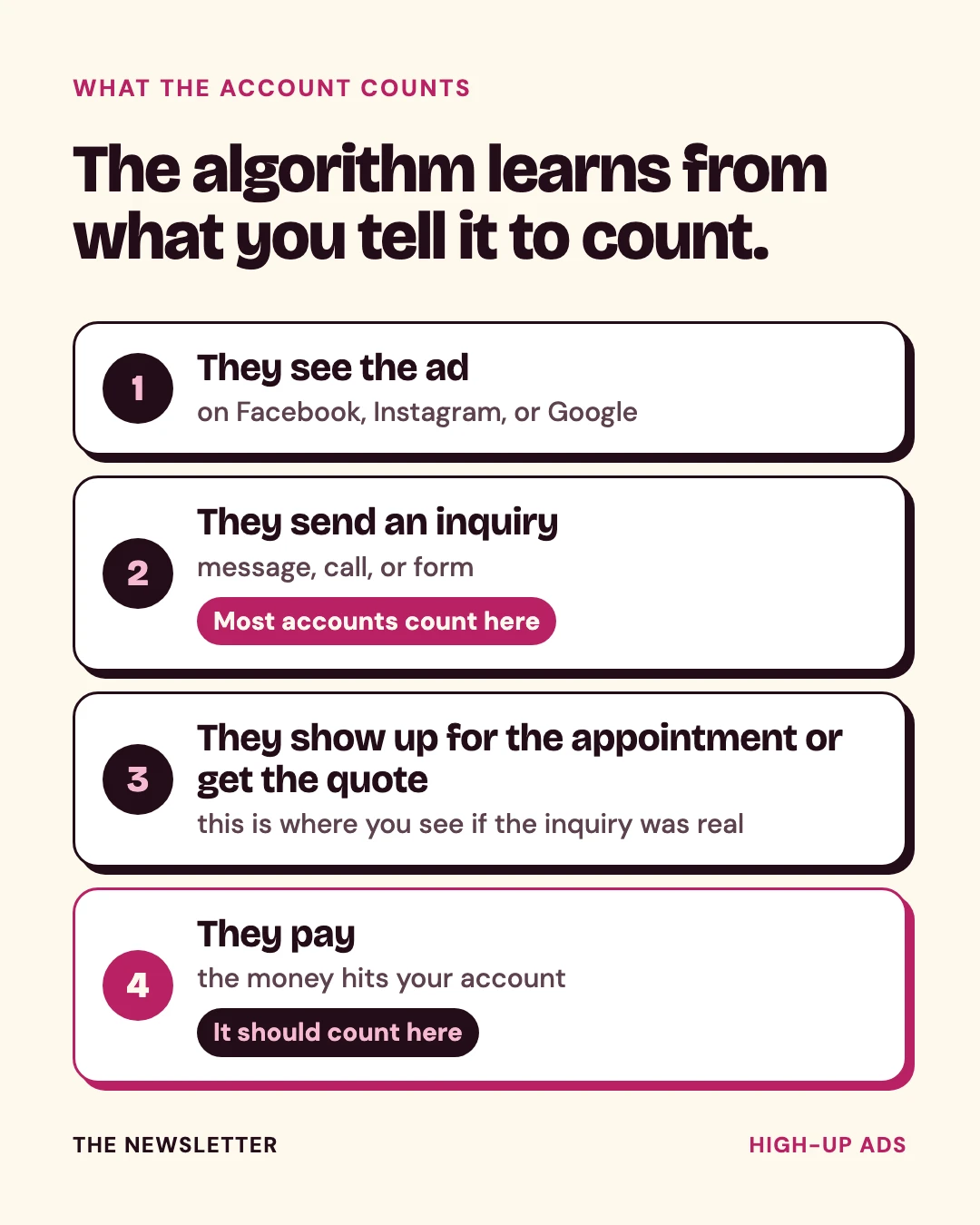
So who tells Google which inquiries turned into customers? Not the agency. The agency can't see your invoices. You can.
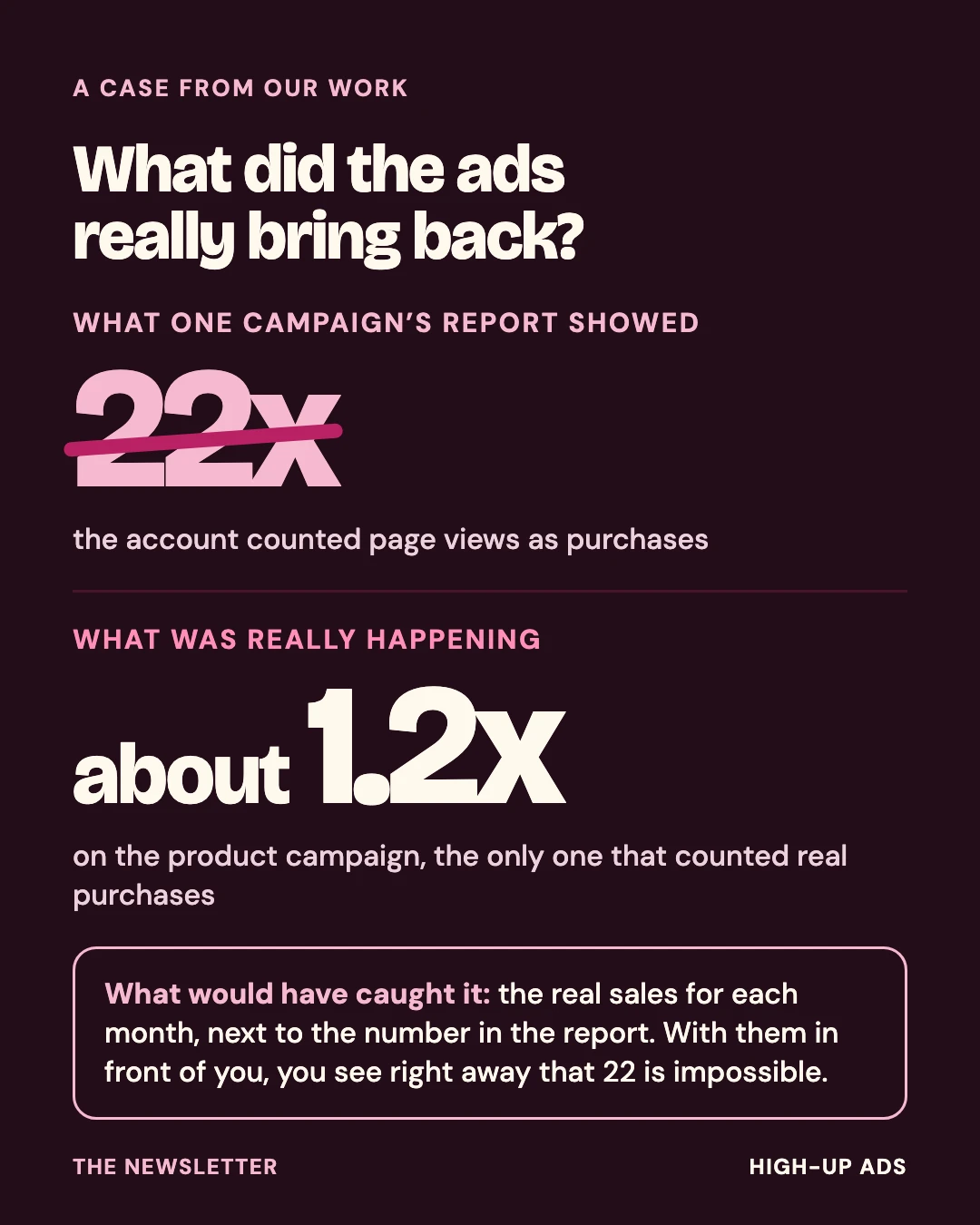
One Google Ads campaign's report showed a 22x return. On the product campaign, the real number was about 1.2x.
This is one of our own cases, and we wrote it up in a full issue: "The Google account was counting sales that didn't exist."
A professional cosmetics store in Romania looked at one Google Ads campaign's report and saw a 22x return on its ad spend: 22 in sales for every 1 spent. The reality on the campaign that showed its products was about 1.2, and that was the only campaign with honest numbers. Across the whole account, it was around 1.
How does that happen? The account was counting someone simply opening a page as a purchase. That's where the 22 came from. The same account had 17 different actions counted as conversions, and about half of them were duplicates: the same action, counted twice. And the automated bidding, the part that decides on its own how much you pay for a click, was chasing YouTube subscribers. For a cosmetics store.
The owner didn't know what the account was counting. That's nothing to be ashamed of. Nobody goes digging through conversion settings for fun.
But one simple sheet with the real sales for each month would have shown right away that 22 was impossible.
Say, as an example, you spend $1,000 a month on ads. At 22 to 1, you should see $22,000 in sales from those ads that month. Open your books. Is it there? If it isn't, something is counting wrong, no matter how pretty the chart looks.
That's what the numbers sheet does. It won't turn you into an ad specialist. It gives you a ruler to hold up against any report you get.
Let's make one.
You'll find the first numbers in your invoices and your appointment book.
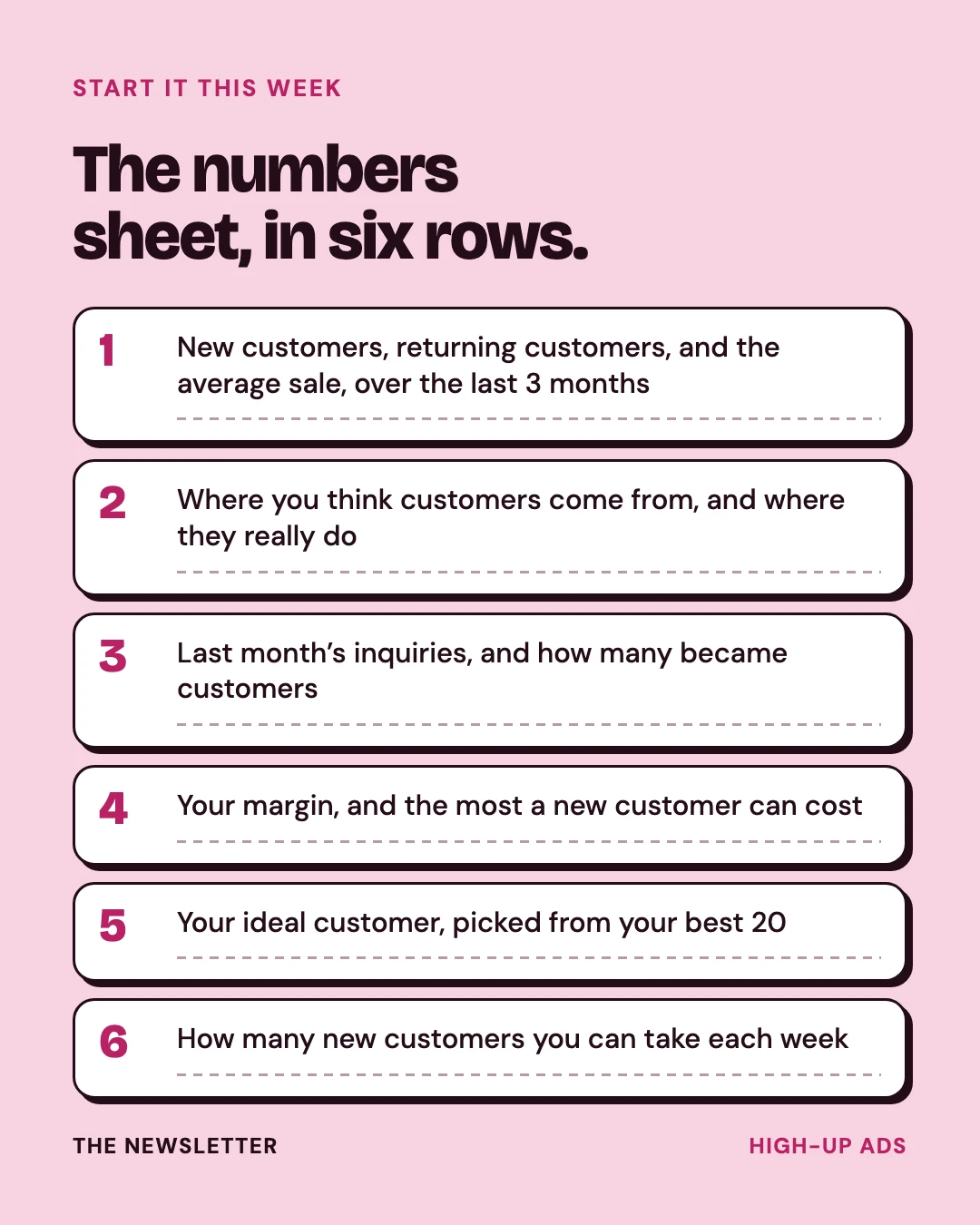
Row 1: your customers over the last three months.
Open your invoices or your appointment book. For the last three months, count:
how many new customers you had,
how many came back,
what an average sale or appointment is worth.
The last three months, not your best month. We know it's tempting to use December, or the month you landed the big job. But if the agency builds its plan on your best month, every normal month will look like a failure. For you and for them.
Row 3: last month's inquiries.
(Row 2 takes longer, so we're saving it for the next section.)
Count how many inquiries you got last month: messages, calls, forms, anything that means "someone asked." Then count how many of them became customers.
Say you had 60 inquiries and 15 customers. One in four.
This number separates two problems that look the same from the outside. If you get few inquiries, you need more people to find out about you. If you get plenty but few become customers, the problem is on the phone, in the quote, or in the price, and more ads only make it bigger.
This is also where you see how much rides on what you count as a sale. If you count forms as sales, you're telling the platform the form is the win. And the platform learns to bring you forms.
Write down where you think customers come from, then count for four weeks.
Row 2: where your customers actually come from.
In the US, about 17% of retail sales happened online in the second quarter of 2026 (Census Bureau). The other 83% didn't. If you run a salon, an auto repair shop, a clinic, or a construction company, you can't read where your sales come from off a report. You have to count.
The counting works like this.
First, before you ask anybody, take a sheet of paper and write down the percentages you believe. How much from Google, how much from Instagram, how much from referrals, how much from past customers. Write them in pen, date the sheet and put it away.
Then, for four weeks, ask every new customer: "Where did you first hear about us?"
No multiple choice. If you ask "Did you find us on Instagram?" you've put the answer in their mouth, and they'll say yes just to be nice. Let them answer in their own words, and write down exactly what they say.
Your front desk can ask, or whoever answers the phone, or you. What matters is that someone asks every single one, not just on the days you remember.
After four weeks, pull out the first sheet and put it next to the tally.
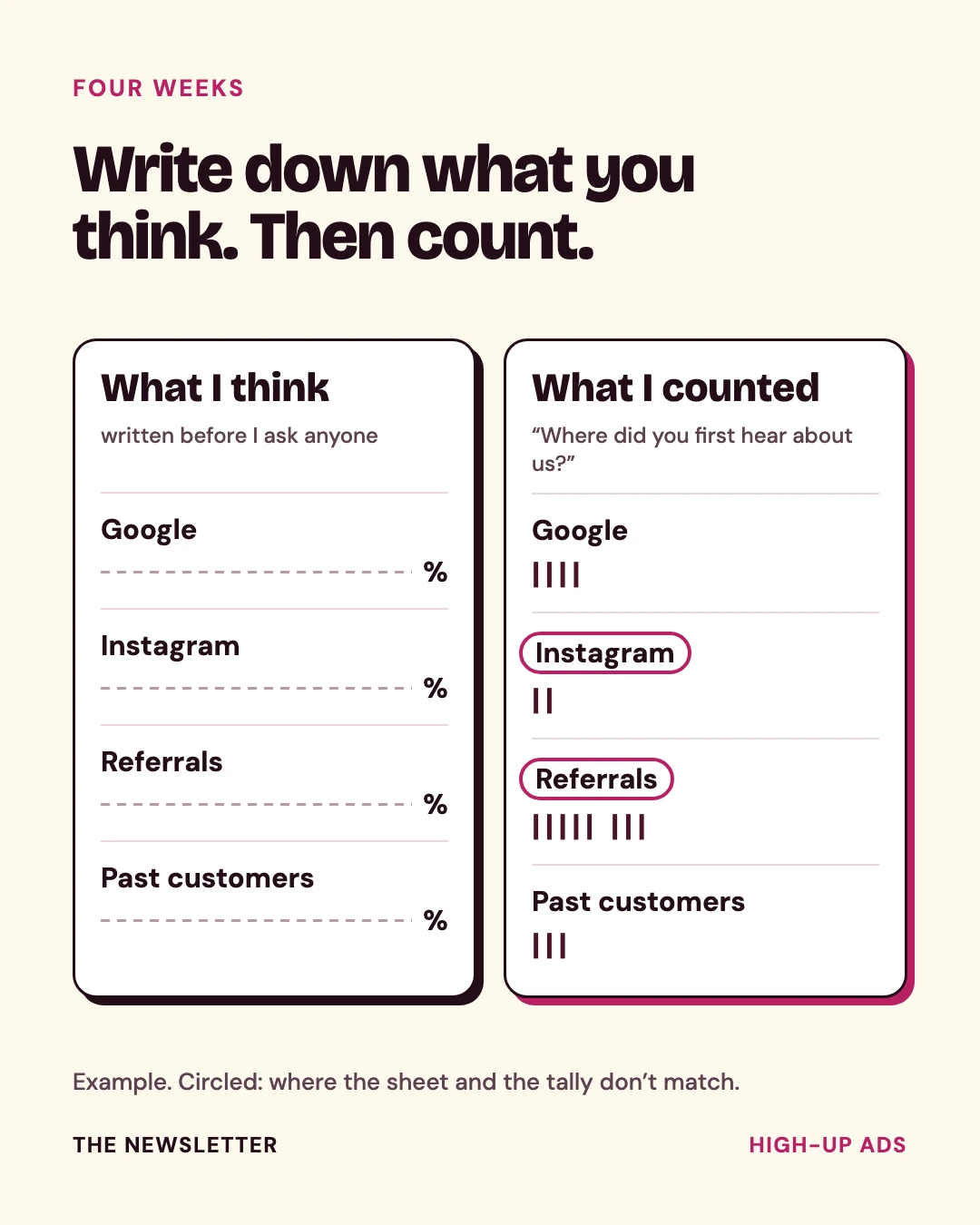
Maybe they match. Then you've got it confirmed in writing and you can move on.
Maybe they don't match at all. Then you just avoided spending money on a channel that doesn't bring you the people you thought it did.
Why the first sheet? Because after four weeks of counting, your brain will tell you "I knew it." The sheet you wrote beforehand won't let it. That's how you keep yourself honest.
Your margin tells you how much a new customer is allowed to cost.
Row 4: your margin and the most a new customer can cost.
Take your main service or product. The one that brings in the most money, not the one you're proudest of.
Write down what's left from it after you take out materials, labor, and anything else that goes directly into it. That's your margin.
From it, you work out the most a new customer can cost you.
Say an appointment leaves you $90. If you spend $120 on ads to bring in a customer who comes once, you lose $30 on every new customer. No matter how good the campaign looks.
If you know from row 1 that some customers come back, that number can move. But it has to exist on paper.
Without it, nobody can tell you whether an ad is expensive. Not the agency, not you, not Google.
This is where we see owners hold back most often: they hide their margin from the agency. We get why. It's not something you tell just anyone. But if the agency doesn't know how much you can afford to pay for a customer, the only thing it can optimize is the cost per click. And a cheap click doesn't mean a profitable customer.
If you don't trust an agency enough to tell it your margin, it's worth asking yourself whether you want to work with it at all.
The last two rows: the customer who leaves you a profit, and how many openings you have each week.
Row 5: your ideal customer.
Ask an owner who their ideal customer is, and the answer is often "everybody." Or "anyone who needs what we do."
There's an old saying: if everybody is your customer, nobody is. An ad written for everybody doesn't stop anybody's scroll.
Your ideal customer isn't the one you like best, the one you'd grab coffee with. It's the one who leaves you the most profit with the fewest headaches.
Finding them takes three steps.
Make a list of your 20 best customers by two measures: how much profit they left and how often they come back. Not by how nice they are.
Look at what they have in common. What they buy, where they live, how they found you, what kind of job or appointment they book.
Then call 5 to 10 recent customers and ask them two things: why they picked you, and who else they looked at before they did.
The answers to that second question are gold. You find out who you're really up against in the customer's head, and it's often not the company you'd guess.
Row 6: how many new customers you can take each week.
The last row. The simplest one, and the one people forget most.
How many new customers can you take each week without the quality slipping? Without your people rushing, without double-booking, without customers waiting two hours.
Say you can take 10 new customers a week. If the ads bring in 30, you've got 20 people who call, can't get in, and leave annoyed. You paid to make enemies.
This number tells the agency how hard to hit the gas. And when to ease off.
That's the whole sheet. Six rows. You fill in five this week, and you let one run for four weeks. With it in hand, any conversation with an agency starts from your business, not from whatever package the agency has to sell.
At the free audit with Oana from HIGH-UP ADS (an hour on Zoom or Google Meet), this sheet is exactly where we start.
But the sheet is yours, and it works no matter who you talk to. So we'll leave you with one question.
- Setup: The truth about agency breakups (6th edition, January 2025)
- Google Ads Help: Performance Max for lead generation
- PYMNTS: The SMB Growth Gap, what leaders track that others miss (survey of 526 US SMBs, May 2026)
- US Census Bureau: Quarterly Retail E-Commerce Sales, 2nd quarter 2026
- HIGH-UP ADS: The Google account was counting sales that didn't exist




Written by the HIGH-UP ADS team: Oana, Lorena, Marian, and Stefan.