

You're paying for ads, or you post all the time. Messages come in. But few turn into appointments, and even fewer turn into customers.
So you do what almost everyone does: you change the ad. New photo, new copy, new audience. Makes sense, because that's where you see numbers.
If you work with an agency, it usually looks at the landing page. That makes sense too, because that's the part it can fix.
So the same two suspects get questioned, one after the other, every time. The third one sits in the corner, and nobody asks it a thing: the offer. Meaning what the person gets, what it costs, by when, and what risk you take off their shoulders.
The good news: you don't need any expensive tool to check your offer. You already have it on your phone. It's what people write to you.
So let's walk through it, step by step.
Put the path from ad to customer on one sheet of paper.
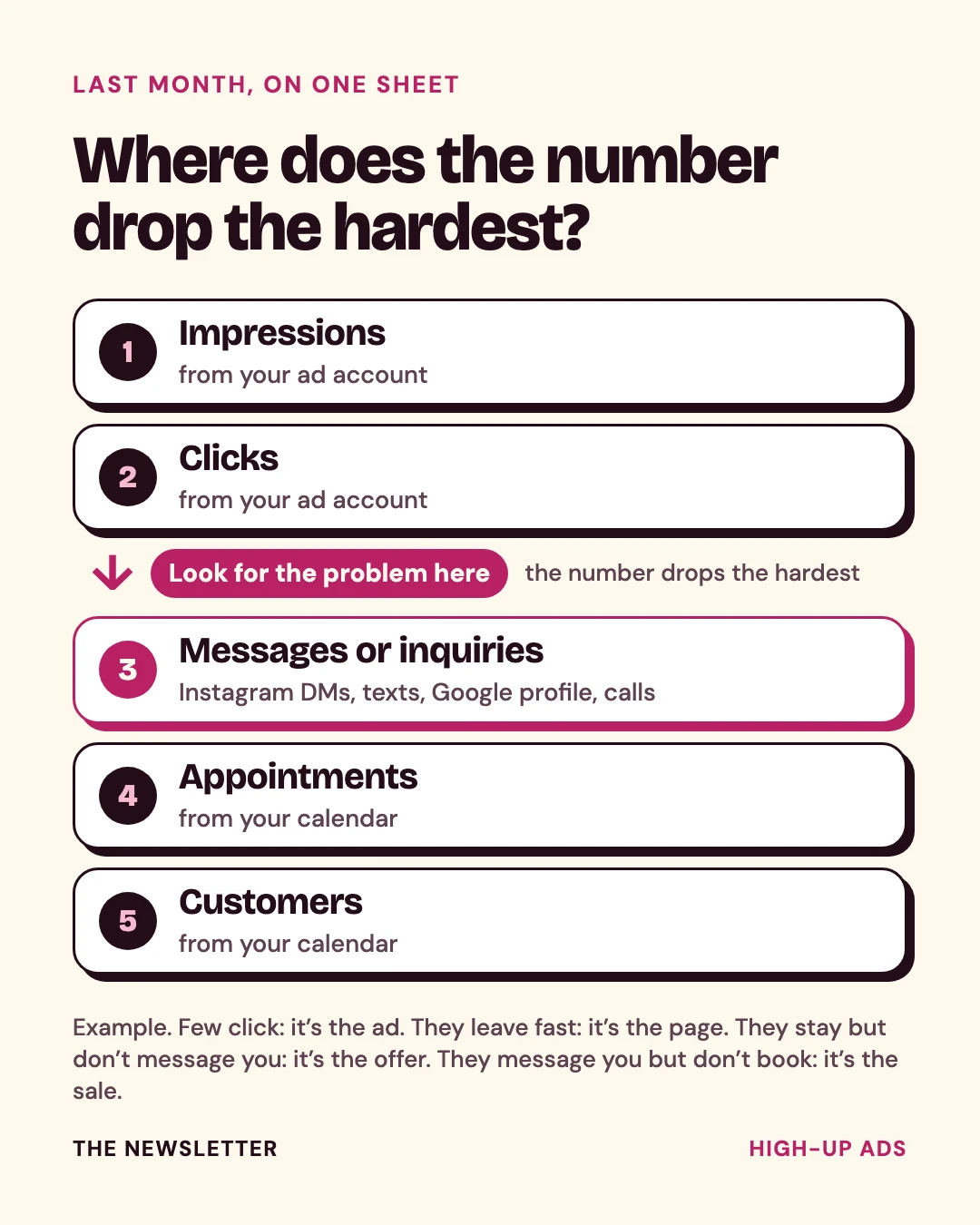
Take last month and write five numbers, one under the other:
1. Impressions
2. Clicks
3. Messages or inquiries
4. Appointments
5. Customers
You'll find the first two in your ad account. Count the messages in your Instagram DMs, your texts, your Google Business Profile, and the calls you wrote down. Appointments and customers are in your calendar.
Now look for the spot where the number drops the hardest. That's where the problem is.
If few people click, it's the ad.
If they leave in the first few seconds, it's the page.
If they stick around but don't message you, it's the offer.
If they message you but don't book, it's the sale.
This is where we see the most expensive mistake: the owner changes the ad when the drop comes after the click. If people click and then go quiet, a new ad just brings you more people who go quiet.
We've seen firsthand how often "the ads aren't working" is the wrong diagnosis. For a professional cosmetics store in Romania, the ads themselves were doing fine: about 3 to 5 out of every 100 impressions ended in a click, at roughly RON 1 (about 22 cents) a click. People wanted the products. The money was getting lost in what the accounts were counting. The Google Ads account was counting page views as purchases, which is how one campaign's report showed 22 in sales for every 1 spent on ads when the real number was about 1.2. We told the whole story in the issue "The Google account was counting sales that didn't exist."
And the other way around: not every lost visitor is the page's fault. 42% of US online shoppers have abandoned a cart because they were "just browsing" or not ready to buy (Baymard Institute, data updated October 2026). Those are people who showed up with no plan to buy, so the problem is the ad and the audience you picked, not the page.
Industry averages give you a ballpark, not a target.
Once your numbers are on paper, you'll want to know if they're good or bad. There are benchmarks for each step.
On Facebook and Instagram, in hundreds of US campaigns that ran between April 2024 and June 2025, traffic campaigns had a typical click-through rate of 1.71%. So out of 100 people who see the ad, 1 or 2 click. A click cost about $0.70. Lead campaigns converted 7.72% of clicks, at a typical cost of $27.66 per lead. That cost ran from about $3 for restaurants to about $77 for dentists (WordStream; the figures are medians).
Two things about these numbers.
First, each median is calculated on its own. You can't multiply them together to figure out how many customers your budget should bring in.
Second, they lump together every city, every price point, and every kind of offer. So don't hold your numbers up against the average like it's the standard you have to hit. Use it as a ballpark. The fairest comparison is still your own last month.
Your last 30 conversations show you where people walk away.
This is the step almost nobody takes, even though it's free.
Open your last 30 conversations with people who asked about you: DMs, texts, calls you wrote down. Make four columns: price, when, where, guarantee. Put each question in its column. If some other question keeps coming up, add a column for it.
You don't need a study. You need 30 conversations, read carefully.
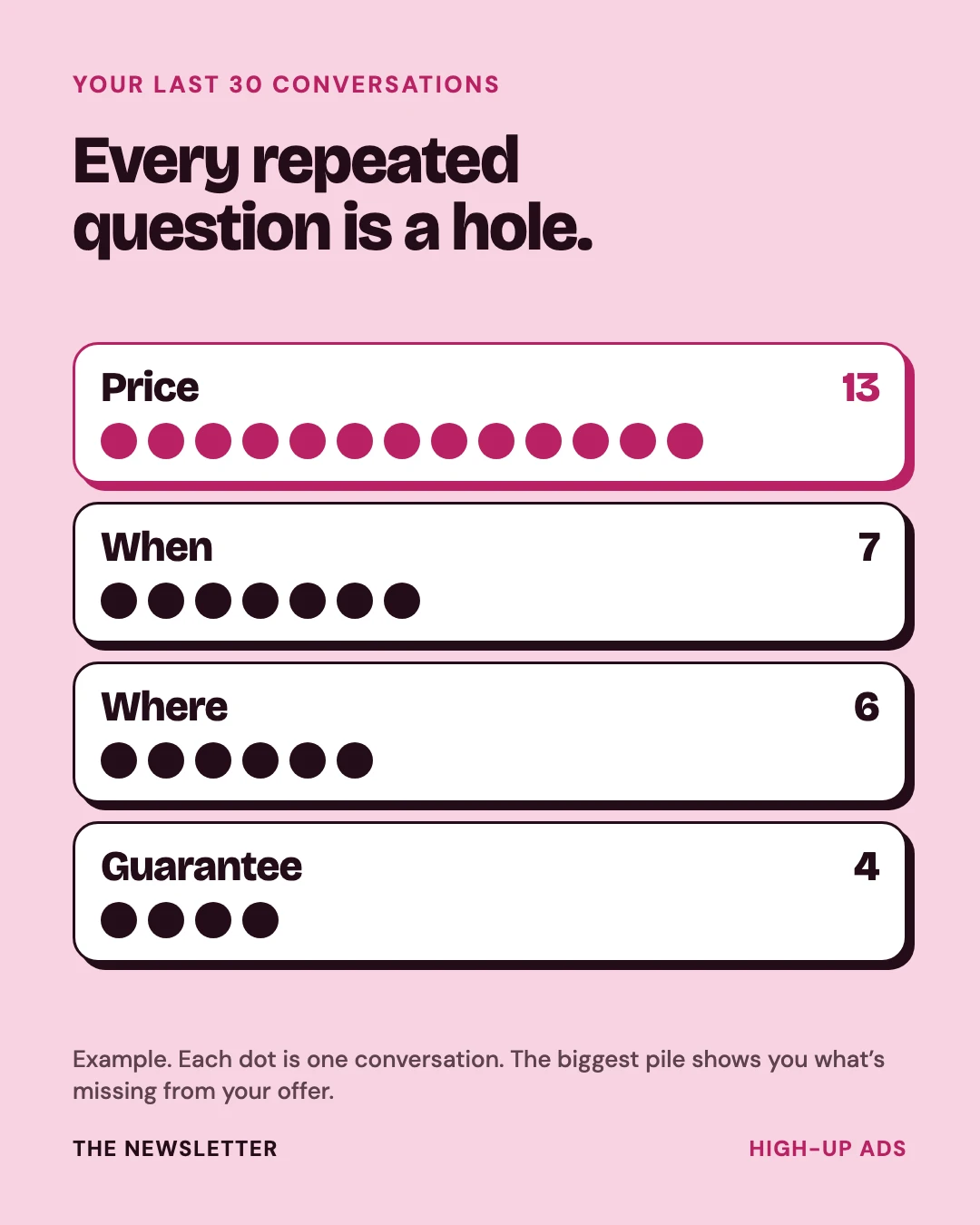
Every question that keeps coming back is a hole. The person looked for the answer in the ad, on the page, or in the offer, didn't find it, and messaged you. Or never reached out and just left, and that one you never see.
Two patterns are worth a close look.
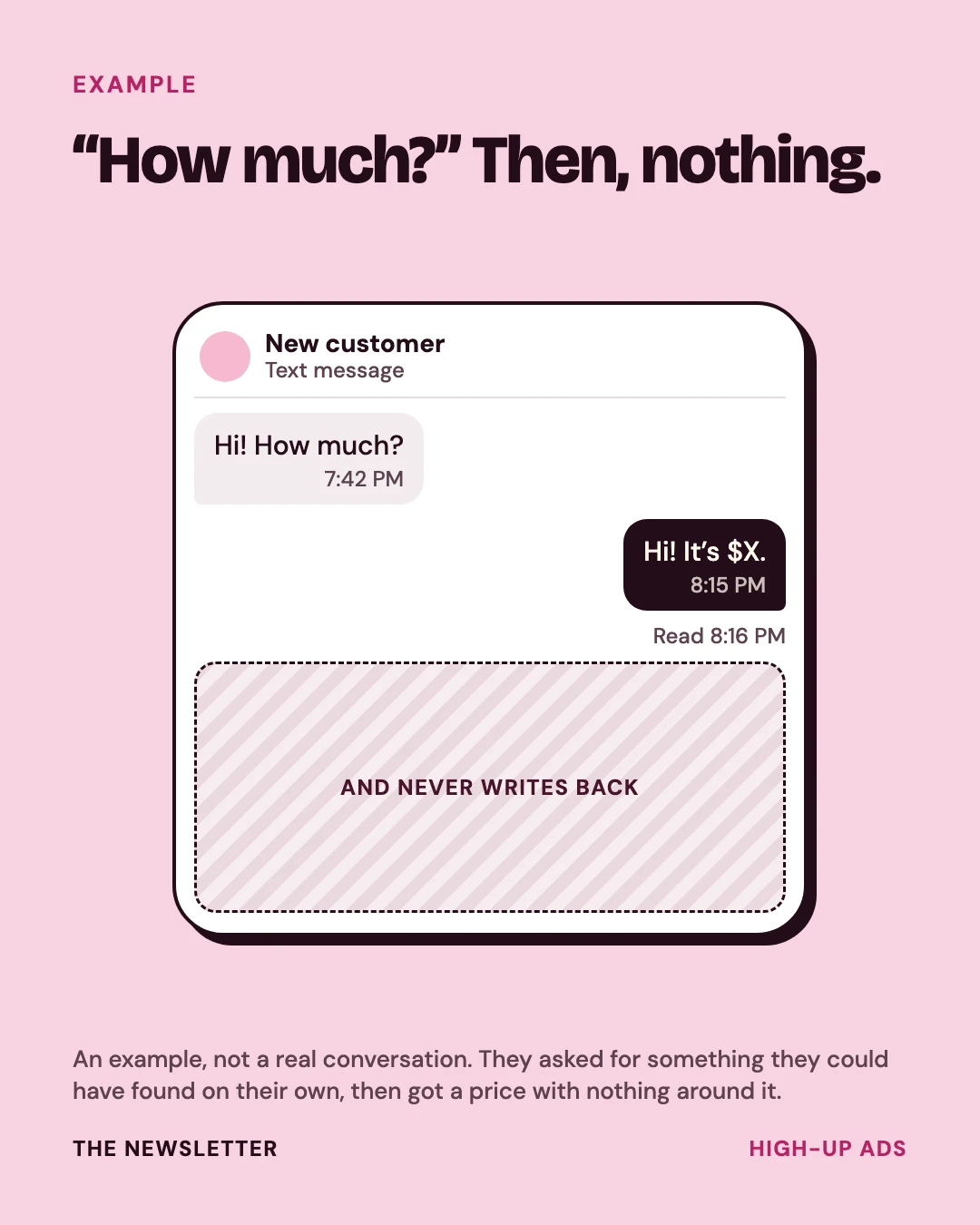
"How much?" over and over. It means the ad and the page are hiding the price. The classic "DM us for pricing" falls in here too. The person messages you, you send the price, and the conversation stops. The owner wonders why, but the answer is simple: they had to ask for something they could have found on their own, then got a price they weren't expecting, with nothing around it to explain it.
Pushback on price after they've seen it. That's a different problem. They know what it costs, but they don't see why it costs that much. No new ad fixes this. It's a problem with the offer and how you position it.
Say most of your 30 conversations land in the price column. Before you touch the ad, you already know what's missing.
Write your offer in one sentence with four parts.
Now look at what you tell people they'll get. Most businesses write "quality and professionalism." The trouble is, everybody writes that, and nobody can check it. That's a slogan, not an offer.
An offer has four parts:
1. What the person gets. Be specific, not "top-notch service."
2. What it costs, or at least where the price starts.
3. By when: the dates they can book, or how long the offer lasts.
4. What risk you take on if it doesn't turn out right.
Say you run an auto repair shop. Instead of "honest, professional service," your offer could sound something like this: "Scheduled maintenance on your car, $X with parts and labor, openings through Friday, and if anything we worked on gives you trouble afterward, we'll fix it free."
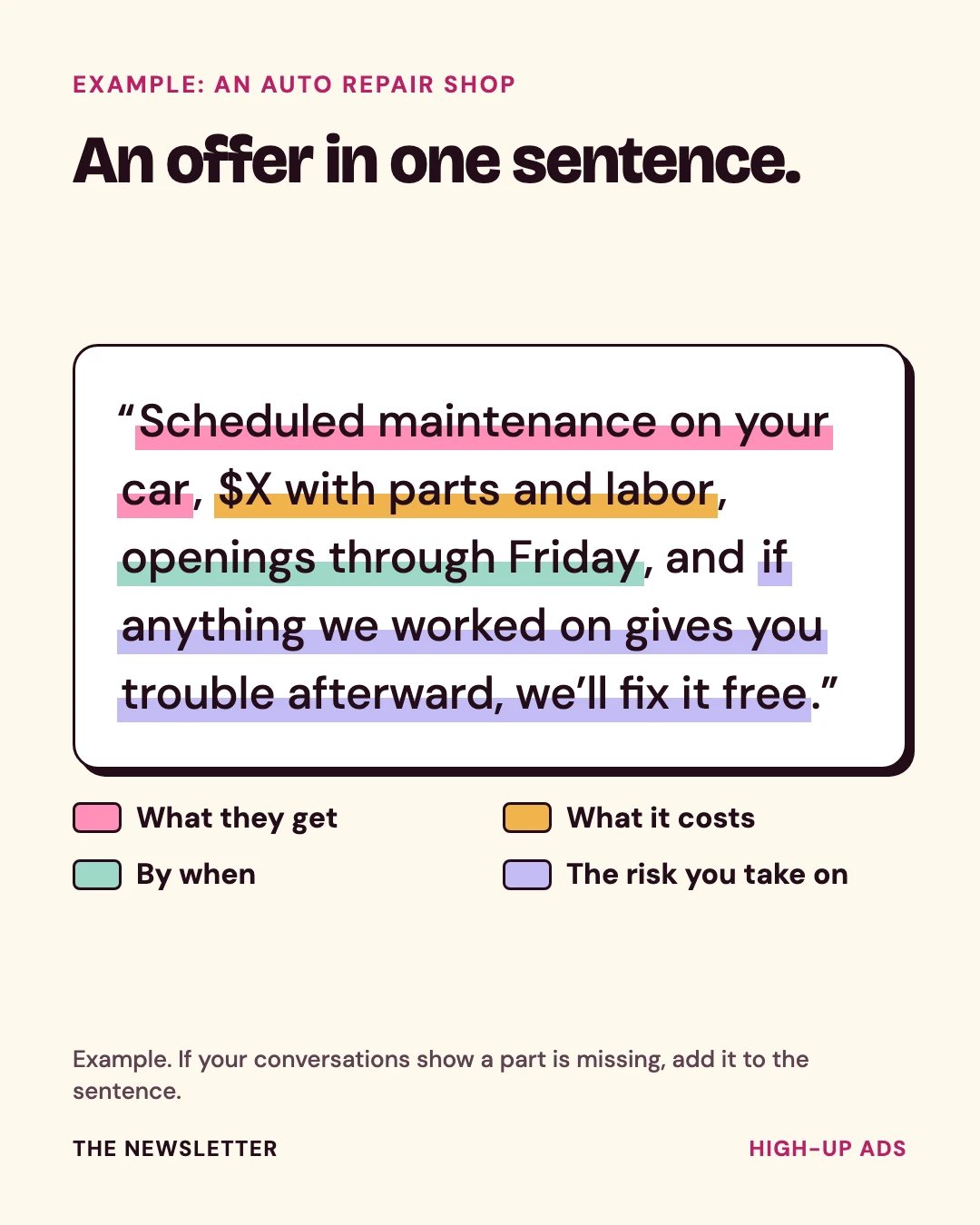
This is where it all ties back to the step before. The columns from your conversations tell you exactly which part is missing from your offer. Lots of "how much?" means the price is missing. Lots of "when can you do it?" means the timing is missing. Lots of "and what if it doesn't work?" means the risk you take on is missing.
Write the sentence, then put it up top: in the ad, in your profile bio, in the first message you send.
Copy that sounds too "professional" loses patients and remodeling jobs.
This one is mainly for clinics and contractors, but anyone can use it.
At clinics and in construction, what loses people is usually the copy, not the design. More precisely, copy that sounds too "professional."
In its 2024 report, Unbounce looked at more than 41,000 landing pages and 464 million visitors between July 2023 and July 2024. Pages written at a 5th to 7th grade reading level converted at 11.1%. Pages written at a "professional" level converted at 5.3%, about half as well. And difficult words had the strongest link to weak conversion rates. For reference, the median conversion rate for landing pages in the same report is 6.6%.
And people don't stick around to decode it. The decision to stay on a page or leave happens in roughly the first 10 seconds (Nielsen Norman Group, based on Microsoft Research data from 2010). The data is old, but the point still holds: if people don't get what you do and who it's for in the first few seconds, they leave.
So read your page or your profile like a 7th grader would. Cut the jargon and the long sentences.
Say a dental practice's profile reads: "We offer oral rehabilitation solutions through minimally invasive implantology procedures." A patient gets this faster: "We'll replace your missing tooth. At your first visit, we'll tell you what it costs and how long it takes."
Or for a remodeling company, instead of "High-standard interior finishing services," you could write: "We'll redo your bathroom. We come out, measure, and give you a price and the date we'll be done."
Both are just examples. The idea is the same: people need to see themselves in the sentence, not see how well you know the terminology.
Your customers find you on their phones, so check everything on a phone.
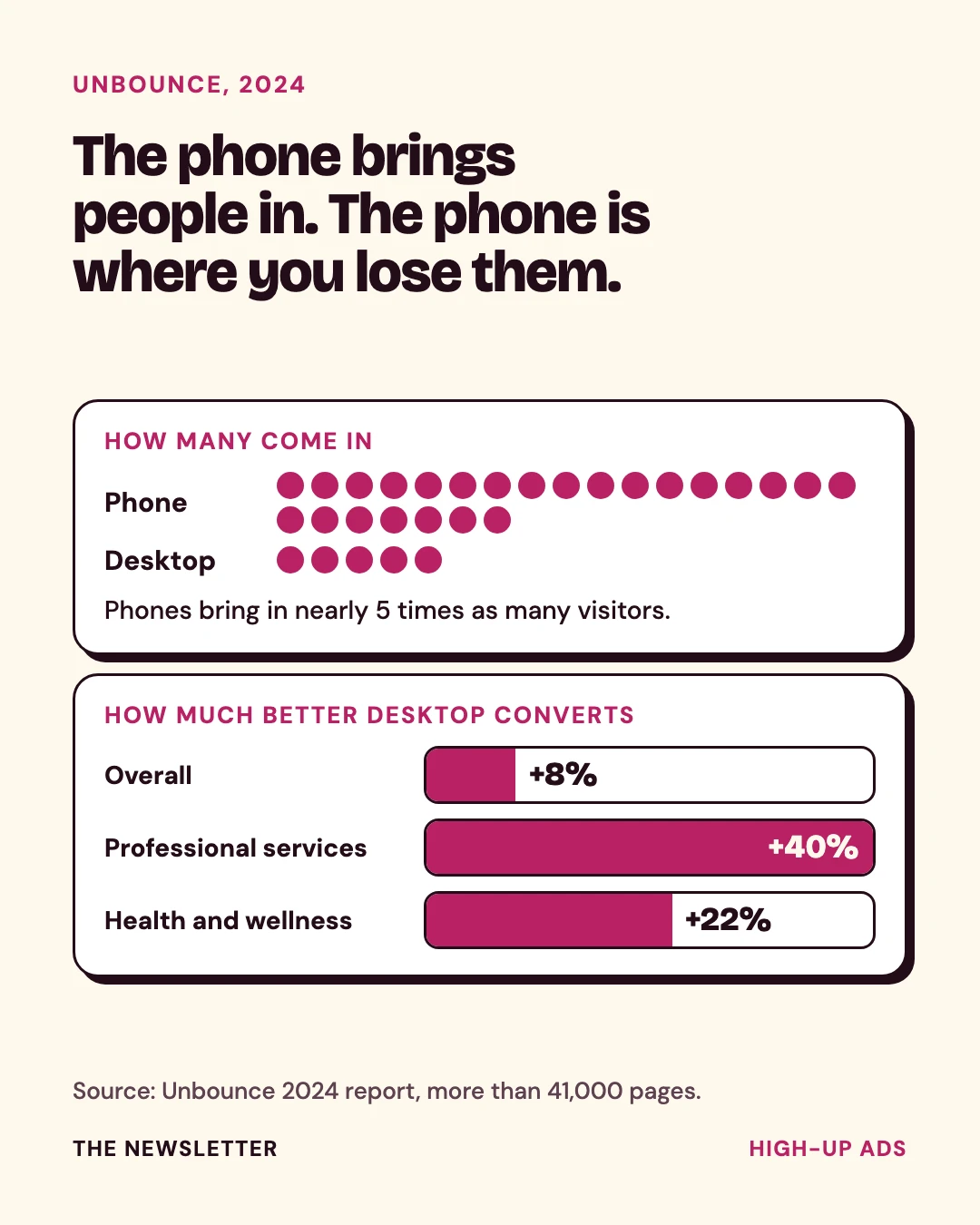
Also from the 2024 Unbounce report: phones bring in nearly 5 times as many visitors, but desktop converts 8% better. For professional services, desktop converts 40% better, and for health and wellness, 22% better.
In short, the phone brings people in, and the phone is where you lose them.
A mistake we see a lot: the owner judges the website from a laptop, where it looks good and loads fast, even though almost all their customers come from a phone. Look at it the way they do.
If you have a website, run it through PageSpeed Insights (it's a free tool from Google) and look at the mobile score. Speed matters more than it seems. On a phone, when load time goes from 1 second to 3 seconds, the chance that someone leaves goes up 32% (Google and SOASTA, 2017). And a mobile site just 0.1 seconds faster raised conversions 8.4% in retail and 10.1% in travel (Deloitte, 2020, a study commissioned by Google).
If your "page" is your Instagram profile or your Google Business Profile, there's nothing to run through PageSpeed. But the copy and the offer matter just as much there.
Then there's the form. A lot of businesses ask for a budget, a ZIP code, and "How did you hear about us?" for the CRM before they've talked to the person even once. Every extra field is one more reason to give up.
For each field, ask yourself: do I need this before the first phone call? If not, cut it.
There's a well-known case where a Chicago web firm cut its contact form from 11 fields to 4, and its conversion rate went up 120%, with no drop in the quality of the leads. It's one site, back in 2008, so don't take it as a rule. But the direction is clear.
If you also sell online, count the orders you kept, not the orders you got.
This part is only for those of you who also run an online store.
US retailers expected 19.3% of online sales to be returned in 2025 (National Retail Federation and Happy Returns, October 2025). Add cancellations and refunds, and the number of orders in your ad account isn't the number of sales you actually kept.
So compare last month's orders with what was still paid for after returns, refunds, and cancellations. The gap between the two is a loss your ad account doesn't show you.
We covered the rest of the steps for online stores in our issue on the store where people come in and don't buy ("Before you change the ad, buy something from your own store on your phone").
This week, read before you change anything.
Don't change a single ad this week.
First, write down the five numbers from last month. Then read your last 30 conversations and group them by question. Only after that do you decide what to change: the ad, the page, or the offer.
If you'd like to go over them with someone, this sheet and your grouped conversations are exactly what we put on the table at the free audit with Oana from HIGH-UP ADS: an hour on Zoom or Google Meet.
- WordStream: Facebook ads benchmarks 2025 (US campaigns), archived copy
- Unbounce: 2024 Conversion Benchmark Report, via PR Newswire
- Unbounce: Conversion Benchmark Report, median conversion rate
- Nielsen Norman Group: How long do users stay on web pages?
- Think with Google: mobile page load time statistics, archived copy
- Deloitte: Milliseconds Make Millions (2020)
- Imaginary Landscape: cutting a contact form from 11 fields to 4 (2008)
- Baymard Institute: reasons for cart abandonment (updated October 2026)
- National Retail Federation: consumers expected to return nearly $850 billion in merchandise in 2025
- HIGH-UP ADS: The Google account was counting sales that didn't exist
- HIGH-UP ADS: Before you change the ad, buy something from your own store on your phone




Written by the HIGH-UP ADS team: Oana, Lorena, Marian, and Stefan.