

Say you start running ads for your salon tomorrow. At 7 pm, three people message you on Instagram asking for a Saturday appointment. The front desk left at 5, you're at dinner, and the work phone is in a drawer. By the next morning, two of them have booked somewhere else.
The ad worked. It brought in exactly the people you wanted. It just brought them to a locked door.
That's where this issue starts. Ads don't fix anything in your business. They take what's already there and turn it up. If you answer fast and your offer is clear, they turn that up. If the phone rings and nobody picks up, they turn that up too, on your dime.
Ads turn up everything you feed them, the good and the bad.
Think of an ad as a speaker. If the person at the mic can sing, the back row hears a good song. If the mic crackles, the back row hears the crackle just as loud.
In a small service business, the crackle usually comes in three forms. The first is a phone or an inbox nobody answers in time. The second is an offer people don't get the first time they read it: what they get, what it costs, when they can come in. The third is an ad account that counts something other than sales, so the platform learns to bring you exactly what you don't need.
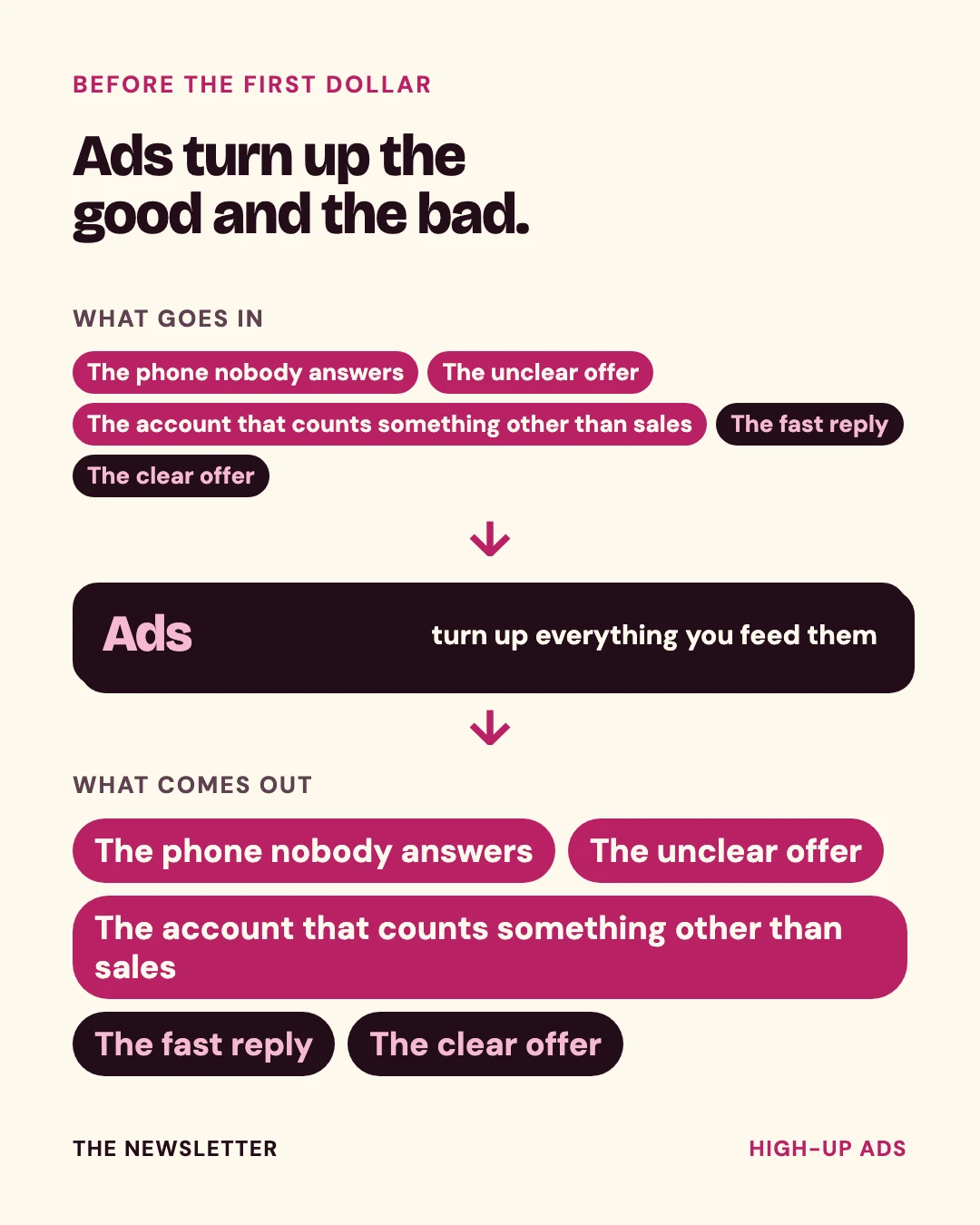
Now the good news, so this doesn't read like we're telling you not to advertise. The speaker works both ways. A fast reply and a clear offer get louder too, and most of what's on this list costs you an evening, not a budget.
So the question isn't whether to run ads. It's what you fix first. Let's go through it one piece at a time.
Start with a 5-minute test on your own business.
We'd do it this week, before anything else.
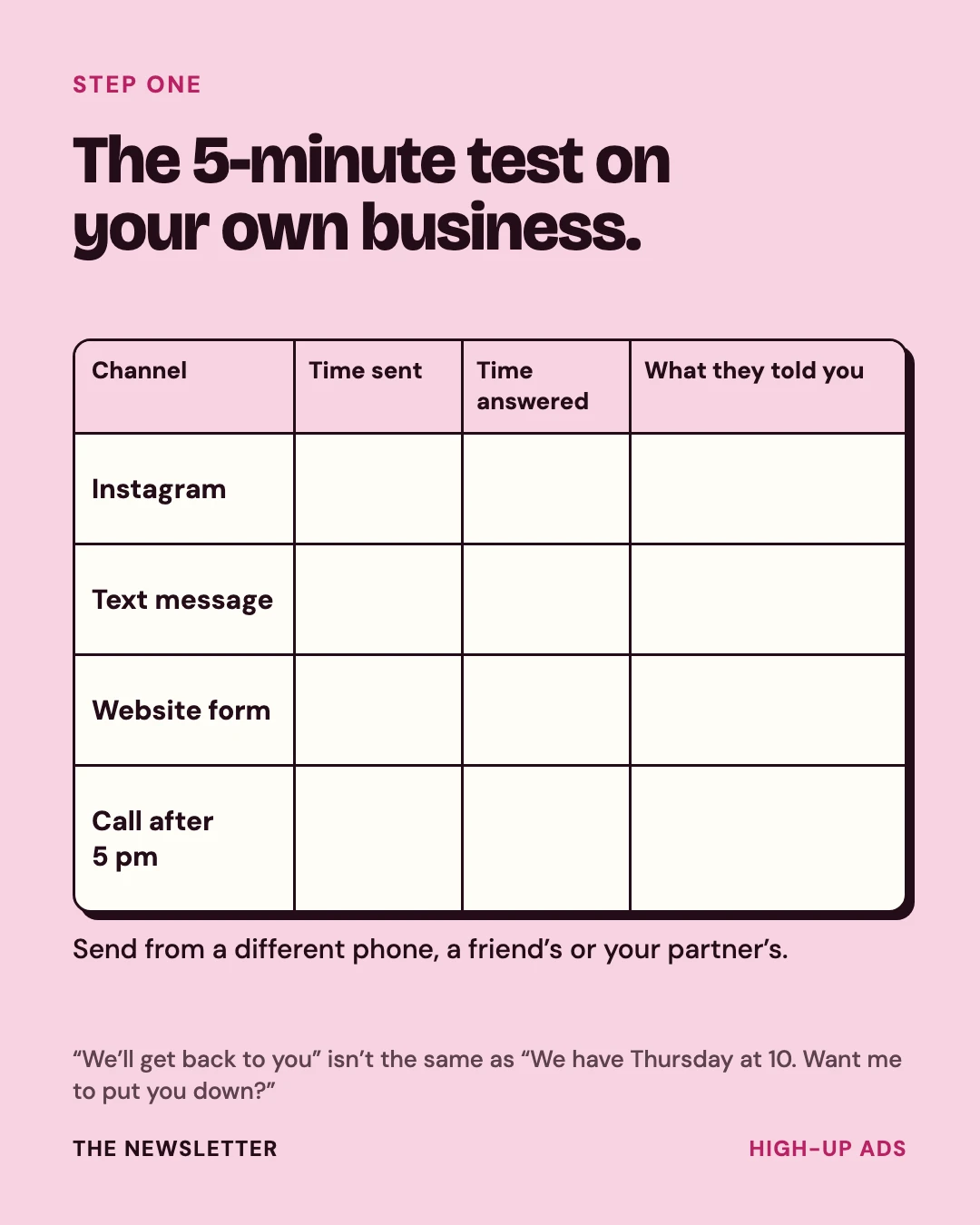
Borrow a different phone, a friend's or your partner's. From it, message your business on Instagram and send it a text. Fill out the form on your website. Then call once after 5 pm.
For each one, write down when you sent it, when you heard back, and what they told you. "We'll get back to you" isn't the same as "We have Thursday at 10. Want me to put you down?"
Why does the first hour matter? In March 2011, Harvard Business Review published an audit of 2,241 US companies. The researchers sent each one an inquiry through its website and timed the reply. Only 37% answered within an hour, and 23% never answered at all. The same article ran a separate analysis on a different set of data: companies that tried to reach a lead within an hour were nearly 7 times as likely to qualify it as companies that tried an hour later.
That's US data from 2011, so don't treat it as a law for your salon. That's exactly why you run the test on your own business instead of reading about it in a study.
If nobody answers within the first hour, that gets fixed first. Before the budget, before the copy, before the photos. What happens to an inquiry after that first reply is a story of its own, and we covered it in our issue on inquiries that don't turn into jobs.
Count your inquiries, your customers, and the open slots in your calendar.
How many inquiries did you get last month? How many turned into customers?
If the answer is "a bunch" and "maybe half," you're not counting them. And this isn't about paperwork. If you don't know which inquiry became a customer, neither does the platform. So it does the only thing it can do: it brings you form fills. Lots of them, cheap, and some from people who'll never show up.
Set up tracking first. A simple spreadsheet works: the date, where the person came from, what they asked for, and whether they became a customer. What matters is that every inquiry ends with a yes or a no.
While your calendar's open, check one more thing. How many new customers can you take a week? If you're already booked weeks out, ads won't get you more customers. They'll get you people who wait longer, and some of them will go somewhere else. Start ads when you have room, not when you already have a line.
Your minimum budget comes from what a customer costs you.
This is the math almost nobody walks a small business owner through.
Ad platforms learn from results. On Facebook and Instagram (Meta), the usual benchmark for getting out of the learning phase is about 50 results per ad set in 7 days. The ad set is the group with its own budget and its own audience. Below that, the ad set gets flagged "Learning limited," which means it learns slowly, and big edits can restart the learning.
It's a benchmark, not a law. Jon Loomer, a well-known Meta ads practitioner, calls the learning phase more of a guide than a hard rule and says there are times when 50 conversions a week just isn't realistic. The direction still holds: the fewer results the platform sees, the more it guesses.
Practitioners (not Meta) use a simple rule of thumb. Your minimum daily budget is at least your target cost per result × 50 ÷ 7. Per week, it's that cost × 50.
Say you can spend $15 in ads to book one appointment. Then 50 appointments a week comes to $750 a week, on a single ad set. It's only an example, so run the math with your own numbers.
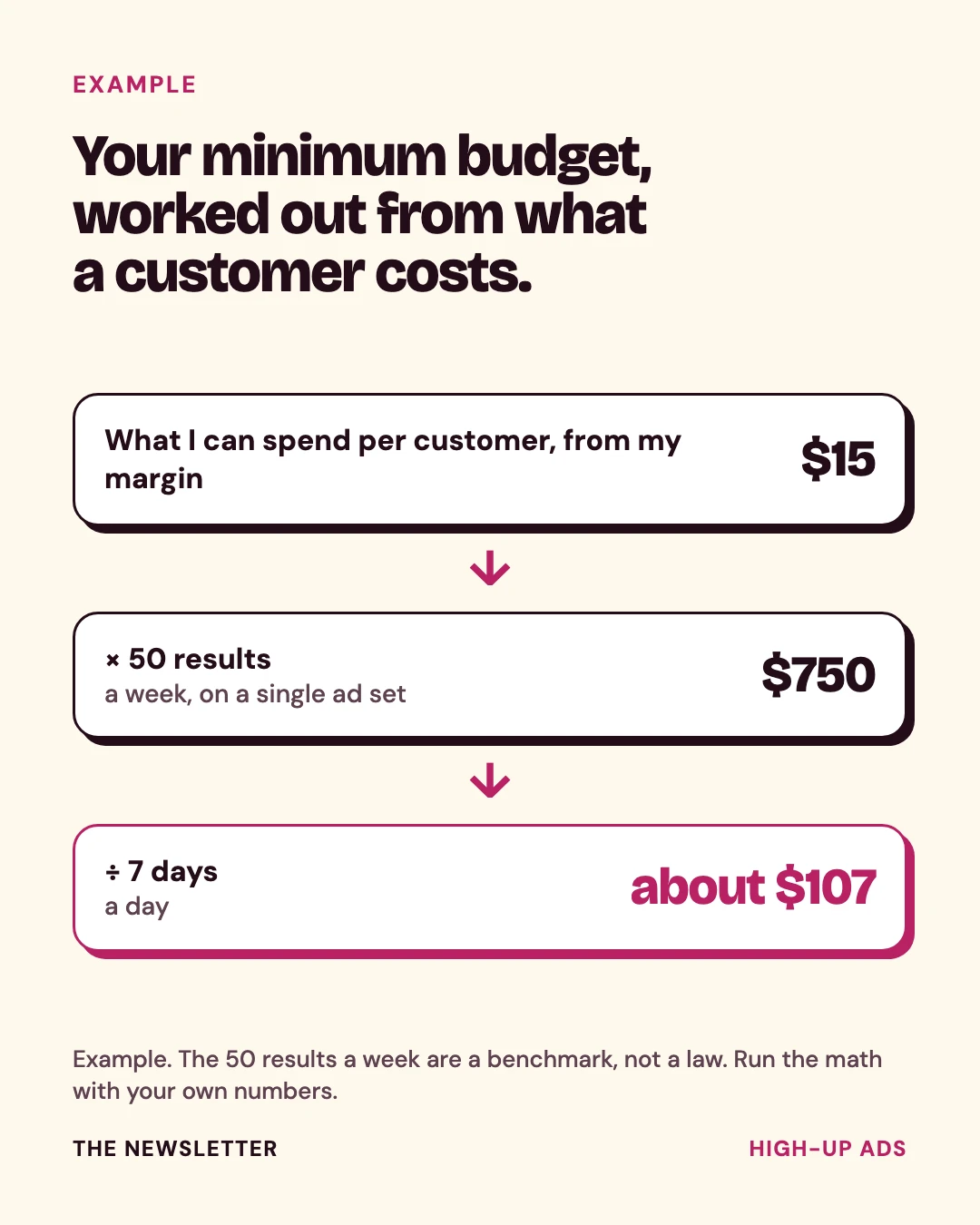
That $15 starts with your margin. First you figure out what you make from a new customer and the most you can spend to get one without losing money. Skip that math and you can have ads that bring in customers and still lose money on every one.
And if you can't keep up $750 a week? Don't quit. Run one campaign and optimize it for a result that happens more often but still shows intent. The classic mistake is the opposite: a small budget split across five campaigns. Each one gets a few results, none of them gets enough, and none of them learns anything.
On Google, the guide for Performance Max campaigns that bring in leads says that if you use value-based bidding, you should pick a conversion goal as close to a sale as you can, with at least 15 conversions in the last 30 days. Google says to give it 1 to 2 weeks before big changes, and up to 6 when volume is low. And a cost target set too low holds you back: ask for customers well below what they really cost, and Google will show your ads less.
Your account should count one thing, the one that makes you money.
Open your ad account and look at what's counted as a conversion. There should be one primary action, the one that means money: a purchase, an appointment the customer actually showed up for, a qualified lead. Keep the rest as information, but take them out of primary.
Why so careful? Because the automation does exactly what you tell it. We saw it with a professional cosmetics store in Romania, in our issue on the account that counted sales that didn't exist. In short, three things were wrong.
The Google Ads account counted page views as purchases. That's why one campaign's report showed 22 in sales for every 1 spent on ads, when the real return on the product campaign was about 1.2 to 1.
Separately, the account counted 17 actions as conversions, and about half of them were duplicates. The primary actions were two YouTube actions, one of them channel subscriptions. So automated bidding was hunting for people who'd subscribe, not people who'd buy.
On Facebook, about 78% of the sales campaign budget was set to bring in add-to-carts and started checkouts. The platform delivered exactly that. It came to 7 orders on RON 5,355 of ad spend (Romanian lei; about $1,182 at the June 3, 2026 exchange rate).
The automation worked perfectly. It just followed the wrong instructions. We fixed the tracking on both platforms first, and only then rebuilt the campaigns.
Once the account counts the right thing, you launch and leave it alone for 2 to 6 weeks, unless something's obviously broken. If you change something every three days, you restart the learning every time and pay for the same lesson over and over.
The AI inside the platforms does exactly what you tell it to count.
Maybe you're thinking: "Fine, but I've got ChatGPT or Claude, and Facebook and Google have automated campaigns. Why would I need an agency?"
Fair question. Let's look first at what the AI in the platforms actually does.
On Google, AI Max for Search matches searches beyond the keywords you picked, writes ad text from your ads, your landing page, and your assets, and sends people to other pages on your site. With that last setting (final URL expansion) turned on, the headlines you pinned aren't respected anymore. You still control brand inclusions and exclusions (your own business name included), URL exclusions, and locations. Starting May 27, 2025, Google began moving brand exclusions for Search campaigns into AI Max. Google's AI Max page doesn't give a single performance number.
On Meta, Advantage+ sales campaigns pick the audience, the placements, and how the budget gets split. You supply the goal, the creative, and the total budget. Advantage+ creative uses generative AI to adjust your ad copy and aspect ratios, and even adds motion. And for sales, leads, engagement, and app campaigns, Meta is rolling out a change that removes manual placement choices at the ad set level, according to October 2026 coverage of Meta's help page.
How well does all this work? Almost every number comes from whoever sells the tool. Meta says that for every dollar spent with its Advantage+ products, advertisers generate on average $4.52 in revenue, a 22% increase over business-as-usual campaigns (Meta, April 2025). Optmyzr, a company that sells PPC software, looked at 503 accounts in February 2025. In 91.45% of them, the same keywords showed up in both Search and Performance Max. When the difference in conversion rate was significant, Search won about three times as often. But in 74.92% of the comparisons the difference wasn't significant, and cost per sale and return on spend weren't measured at all. The platforms say their tools work. We haven't found anyone independent who has checked that for small businesses.
Think of Advantage+, Performance Max, and AI Max as very hard-working employees. They do exactly what they're told to count. If a form fill is logged as a sale, they bring you form fills, spam included. Google itself acknowledges the lead quality problem in Performance Max. It recommends lead scores, predicted lifetime value, goals like "qualified lead," reCAPTCHA, and regular checks of where your ads show up. It also suggests qualifying questions on your form and a location setting that targets people who are actually in your area or regularly there, so you stop getting inquiries from outside it. Practitioners put it more bluntly: without data on which inquiries became customers, Performance Max for leads pulls in a lot of spam, because to Google a spam form fill looks like a conversion.
There's one more trap. If you don't exclude your business name from Performance Max and AI Max, those campaigns take credit for customers who were already searching for you by name. You pay for them, and the campaigns look better than they are. Add the exclusion, or track searches for your business name separately.
Then there's the raw material. ChatGPT or Claude will write you 20 ads in a minute, but they only rework what you give them. Give them your real reviews, your prices, and photos and clips from the job. Without those, you get copy that could belong to any salon in the country.
And some news that changes the picture: you're not falling behind. The Census Bureau regularly asks US businesses whether they've used AI in the past two weeks. Between December 2025 and May 2026, 17% to 20% said yes, for anything from marketing to finance. Among firms with fewer than 20 employees, that share didn't change significantly over those five months. The risk isn't falling behind on tools. The risk is turning them on without measuring correctly and then believing the platform's numbers.
Three decisions stay with a person, no matter how automated the campaign is.
The algorithm pushes the buttons. Three decisions aren't its to make.
The first is what gets counted. The algorithm optimizes for whatever you give it, whether that's a form fill, a subscription, or an appointment someone actually showed up for.
The second is what the algorithm isn't allowed to do: take credit for your business name, send people to the wrong pages, bring in inquiries from another city.
The third is when to stop a campaign that looks good in the platform but doesn't put money in the bank. Once a month, put the platform's number next to the money that actually came in, and stop whatever doesn't match. The most expensive mistake people make running their own ads is never stopping anything, because in the platform everything "looks good."
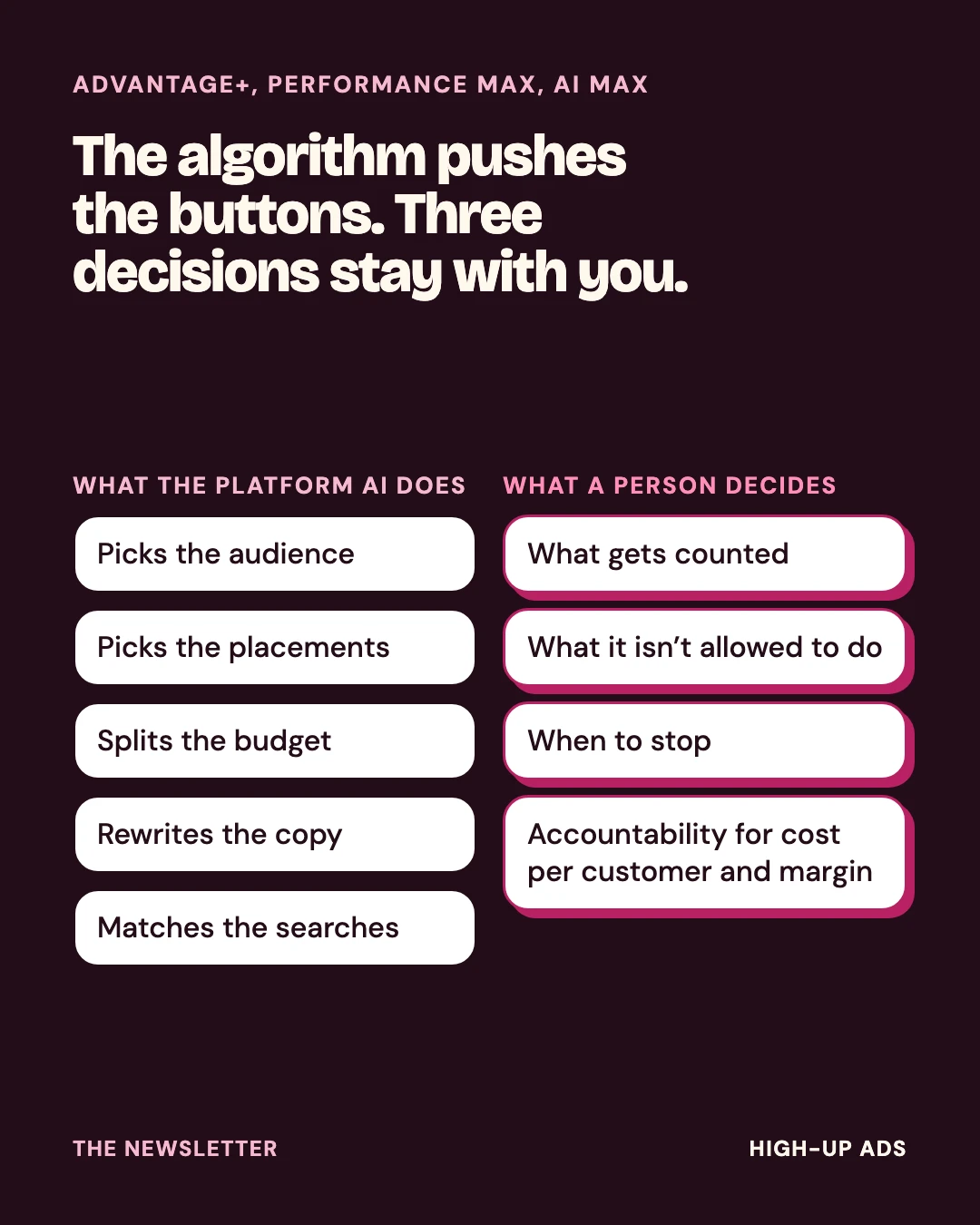
On top of those three decisions, there's accountability. No tool answers for your cost per customer, your margin, or what got shut off in time.
To be fair, not everyone needs an agency. A salon with one campaign and accurate tracking can handle it alone. Just decide ahead of time when you'll bring in outside help: when you're on several channels, when bad inquiries start coming in, or when the money you waste each month is more than an agency fee.
And if you'd like to talk it through, the free audit with Oana is an hour on Zoom or Google Meet, and it starts right here, with the 5-minute test and with what your account counts.
- Harvard Business Review: The Short Life of Online Sales Leads (March 2011)
- Meta Business Help Center: About the learning phase
- Meta Business Help Center: About Learning limited
- Jon Loomer: The learning phase is just a label
- Lebesgue: Budgeting for the Facebook ads learning phase
- Google Ads Help: Performance Max for lead generation
- Google Ads Help: AI Max for Search campaigns
- Google Ads Help: Brand exclusions in Performance Max and Search campaigns
- Meta for Business: Meta Advantage+ explained in two minutes (April 2025)
- Relevant Audience: Meta placement controls on Sales, Leads, Engagement, and App campaigns (October 2026)
- Optmyzr: Is Performance Max cannibalizing Search? (503 accounts)
- Search Engine Land: Why Performance Max for lead generation often fails
- US Census Bureau: Large firms with at least 20 employees biggest AI users (May 2026)
- HIGH-UP ADS: The Google account was counting sales that didn't exist
- HIGH-UP ADS: Plenty of leads, few signed jobs. Where are they going?




Written by the HIGH-UP ADS team: Oana, Lorena, Marian, and Stefan.